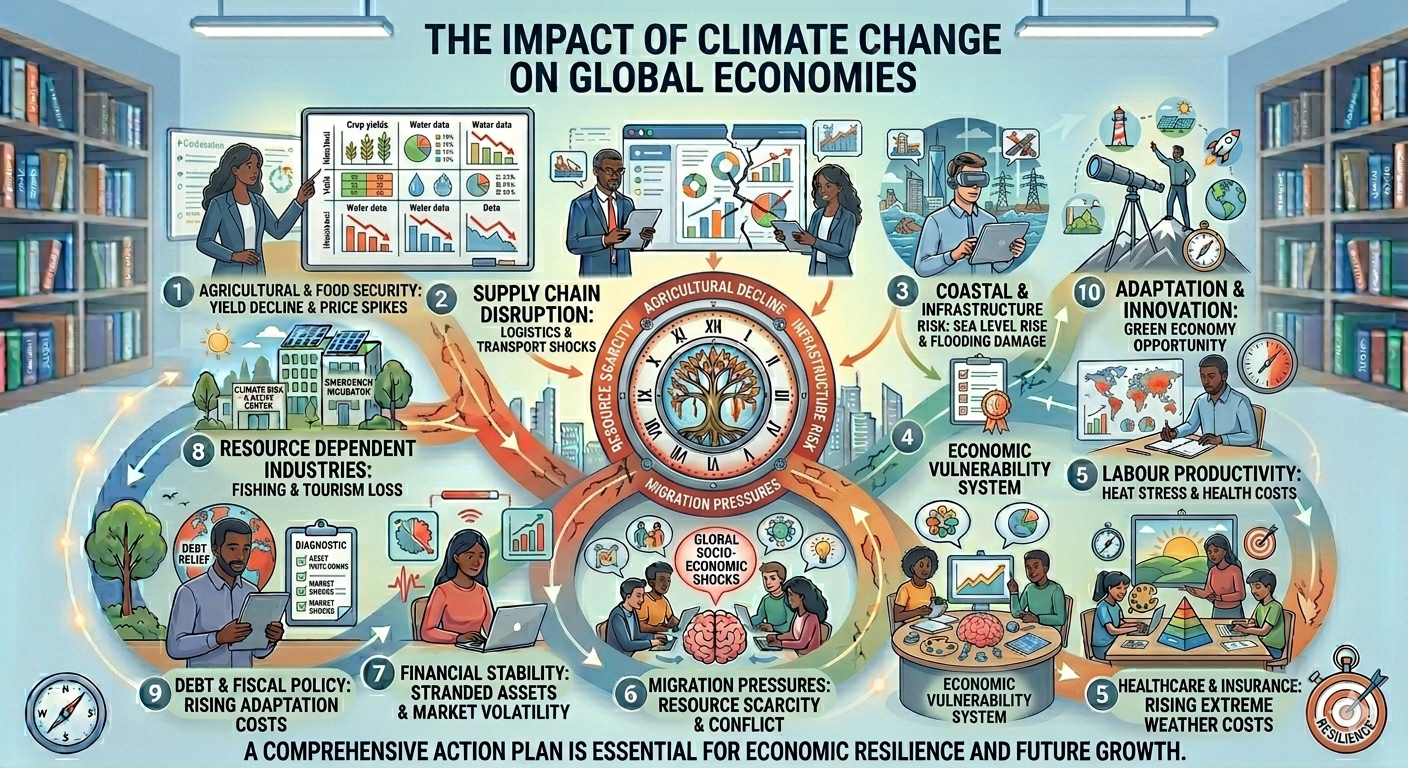
Climate change is no longer a distant environmental concern—it is a present and escalating global economic issue. Rising temperatures, extreme weather events, shifting ecosystems, and sea-level rise are not only affecting natural systems but also reshaping economies, industries, and financial stability across the world.
From agriculture and infrastructure to global trade and labor productivity, the economic consequences of climate change are vast and complex. Understanding these impacts is essential for governments, businesses, and individuals seeking to navigate an increasingly uncertain future.
Understanding Climate Change and Its Economic Relevance
Climate change refers to long-term alterations in temperature, precipitation, and weather patterns, primarily driven by human activities such as greenhouse gas emissions.
Organizations like
Intergovernmental Panel on Climate Change (IPCC)
provide comprehensive scientific assessments showing how climate change is influencing both environmental and economic systems.
The connection between climate change and the economy lies in the fact that all economic activities depend on stable environmental conditions. When those conditions change, economic systems are disrupted.
Key Economic Channels Affected by Climate Change
Climate change impacts economies through multiple interconnected channels:
- Physical damage to infrastructure
- Reduced agricultural productivity
- Increased health-related costs
- Disruptions in supply chains
- Financial market instability
Each of these factors contributes to both short-term losses and long-term economic shifts.
Impact on Agriculture and Food Security
Agriculture is one of the most climate-sensitive sectors.
Changes in temperature and rainfall patterns affect crop yields, leading to:
- Reduced food production
- Increased food prices
- Greater risk of food shortages
Droughts, floods, and extreme weather events can devastate crops and livestock.
Research from
Food and Agriculture Organization (FAO)
highlights how climate change threatens global food security and rural livelihoods.
Developing countries are particularly vulnerable due to their reliance on agriculture.
Effects on Infrastructure and Urban Economies
Climate change causes significant damage to infrastructure, including:
- Roads and bridges
- Buildings
- Energy systems
Extreme weather events such as hurricanes and floods increase maintenance and repair costs.
Cities, especially coastal ones, face risks from rising sea levels. This leads to:
- Property damage
- Increased insurance costs
- Reduced investment
Urban economies must invest heavily in climate-resilient infrastructure.
Impact on Global Trade and Supply Chains
Global trade depends on stable transportation networks and predictable production.
Climate change disrupts supply chains through:
- Port closures due to storms
- Transportation delays
- Reduced production capacity
These disruptions increase costs and reduce efficiency in global markets.
International organizations like
World Trade Organization (WTO)
are increasingly addressing the relationship between climate change and trade.
Labor Productivity and Workforce Impact
Rising temperatures affect worker productivity, particularly in sectors such as:
- Construction
- Agriculture
- Manufacturing
Heat stress reduces working hours and efficiency, leading to economic losses.
Additionally, climate-related health issues increase absenteeism and healthcare costs.
Financial Markets and Investment Risks
Climate change introduces new risks to financial systems.
These include:
- Physical risks from natural disasters
- Transition risks from shifting to low-carbon economies
- Liability risks from environmental regulations
Investors are increasingly considering climate risks in their decisions.
Organizations like
World Bank
emphasize the need for climate-resilient financial systems.
Energy Sector Transformation
The energy sector is both a contributor to and a victim of climate change.
The shift toward renewable energy is transforming global markets.
Key changes include:
- Increased investment in solar and wind energy
- Decline of fossil fuel industries
- Growth of green technologies
This transition creates both opportunities and challenges for economies.
Costs of Climate Disasters
Natural disasters linked to climate change result in massive economic losses.
Examples include:
- Hurricanes
- Floods
- Wildfires
These events:
- Destroy infrastructure
- Disrupt businesses
- Require costly recovery efforts
Insurance industries are also heavily impacted.
Inequality and Economic Disparities
Climate change exacerbates existing inequalities.
Developing countries and vulnerable populations are disproportionately affected due to:
- Limited resources
- Dependence on climate-sensitive sectors
- Weak infrastructure
This creates a widening gap between rich and poor nations.
Government Spending and Policy Responses
Governments must allocate significant resources to:
- Disaster response
- Infrastructure adaptation
- Environmental protection
Climate policies also influence economic activity through:
- Carbon pricing
- Emission regulations
- Green investments
Policy decisions play a critical role in shaping economic outcomes.
Opportunities in the Green Economy
Despite challenges, climate change also creates economic opportunities.
The green economy includes:
- Renewable energy
- Sustainable agriculture
- Green construction
- Clean technology
These sectors generate jobs and drive innovation.
According to
United Nations Environment Programme (UNEP)
the transition to a green economy can support sustainable development.
Climate Change and Innovation
Climate challenges drive innovation in:
- Energy efficiency
- Carbon capture
- Sustainable materials
Innovation helps reduce environmental impact while supporting economic growth.
Long-Term Economic Projections
Economists predict that climate change could significantly reduce global GDP if not addressed.
Potential impacts include:
- Slower economic growth
- Increased costs
- Reduced productivity
However, proactive measures can mitigate these effects.
Adaptation and Mitigation Strategies
Addressing climate change requires two main approaches:
Adaptation
Adjusting systems to minimize damage.
Examples:
- Building resilient infrastructure
- Improving water management
Mitigation
Reducing greenhouse gas emissions.
Examples:
- Renewable energy adoption
- Energy efficiency improvements
Both are essential for economic stability.
The Role of International Cooperation
Climate change is a global issue requiring collective action.
Agreements like
Paris Agreement
aim to limit global warming and coordinate efforts.
International cooperation helps:
- Share resources
- Promote innovation
- Address global challenges
The Future of Global Economies in a Changing Climate
The future will depend on how effectively societies respond to climate change.
Key factors include:
- Policy decisions
- Technological advancements
- Public awareness
Economies that adapt quickly will be better positioned for success.
FAQs
What is the economic impact of climate change?
It includes damage to infrastructure, reduced productivity, and increased costs across various sectors.
How does climate change affect agriculture?
It reduces crop yields, increases food prices, and threatens food security.
Why are developing countries more affected?
They rely more on climate-sensitive sectors and have fewer resources for adaptation.
What is the green economy?
An economy focused on sustainability, renewable energy, and environmental protection.
How does climate change affect global trade?
It disrupts supply chains and increases transportation costs.
What are climate-related financial risks?
Risks to investments and markets caused by environmental changes and policies.
Can climate change create economic opportunities?
Yes, through innovation and growth in sustainable industries.
What is the role of governments?
To implement policies, invest in infrastructure, and support sustainable development.
How can businesses respond to climate change?
By adopting sustainable practices and reducing emissions.
What is the Paris Agreement?
An international treaty to combat climate change and limit global warming.
Conclusion
The impact of climate change on global economies is profound and far-reaching. It affects nearly every sector, from agriculture and infrastructure to finance and trade. While the challenges are significant, they also present opportunities for innovation, growth, and transformation.
Addressing climate change requires coordinated efforts from governments, businesses, and individuals. By investing in sustainable practices, adopting new technologies, and implementing effective policies, the global economy can adapt to changing conditions and build a more resilient future.
The decisions made today will shape the economic landscape of tomorrow. Taking action now is not just an environmental necessity—it is an economic imperative.