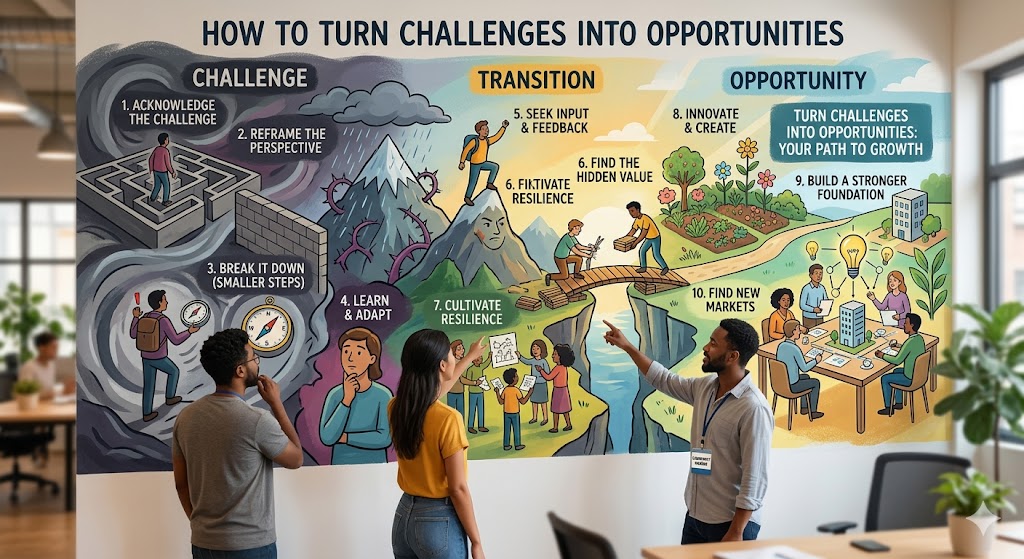
Life is full of challenges—unexpected setbacks, failures, uncertainties, and obstacles that can test your patience, confidence, and resilience. While challenges are often seen as negative experiences, they also hold the potential to become powerful opportunities for growth, learning, and transformation.
The ability to turn challenges into opportunities is not about avoiding difficulties; it’s about changing how you perceive and respond to them. With the right mindset and strategies, you can transform adversity into a stepping stone toward success.
Understanding Challenges and Opportunities
A challenge is any situation that pushes you out of your comfort zone or presents difficulty. An opportunity, on the other hand, is a chance for growth, improvement, or success.
The key difference lies in perception.
What one person sees as a problem, another may see as a possibility.
The Mindset Shift: From Problem to Possibility
The first step in turning challenges into opportunities is shifting your mindset.
Instead of asking:
- “Why is this happening to me?”
Ask:
- “What can I learn from this?”
- “How can this help me grow?”
This shift transforms obstacles into learning experiences.
The Role of a Growth Mindset
A growth mindset is the belief that abilities and intelligence can be developed through effort and learning.
People with a growth mindset:
- Embrace challenges
- Learn from mistakes
- Persist through difficulties
This mindset is essential for turning challenges into opportunities.
Common Types of Challenges
Challenges can arise in different areas of life:
- Personal setbacks
- Career difficulties
- Financial struggles
- Relationship issues
- Health concerns
Each type of challenge offers unique opportunities for growth.
Strategies to Turn Challenges Into Opportunities
1. Accept the Reality of the Situation
Denial prevents progress.
- Acknowledge the challenge
- Understand its impact
- Accept what you cannot control
Acceptance allows you to move forward.
2. Reframe the Situation
Reframing means looking at the situation from a different perspective.
Instead of seeing failure, see:
- A learning experience
- A chance to improve
- An opportunity to try again
3. Focus on What You Can Control
You cannot control everything, but you can control your response.
Focus on:
- Your actions
- Your attitude
- Your decisions
This empowers you to take action.
4. Learn from the Experience
Every challenge teaches something.
Ask:
- What went wrong?
- What can I do differently next time?
Learning turns setbacks into growth.
5. Develop Resilience
Resilience is the ability to bounce back from difficulties.
Build resilience by:
- Staying positive
- Maintaining perspective
- Seeking support
6. Take Action
Opportunities come from action.
- Break the challenge into steps
- Create a plan
- Start small
Progress builds momentum.
7. Embrace Change
Challenges often bring change.
Instead of resisting:
- Adapt to new situations
- Explore new possibilities
- Stay flexible
8. Seek Support and Guidance
You don’t have to face challenges alone.
Seek help from:
- Mentors
- Friends
- Professionals
External perspectives provide valuable insights.
9. Stay Persistent
Success rarely comes without persistence.
- Keep going despite setbacks
- Stay committed to your goals
Persistence turns challenges into achievements.
10. Identify Hidden Opportunities
Challenges often hide opportunities such as:
- New skills
- Better strategies
- Personal growth
- New directions
Look beyond the immediate difficulty.
The Role of Emotional Intelligence
Emotional intelligence helps you manage challenges effectively.
It involves:
- Recognizing emotions
- Controlling reactions
- Understanding others
This improves decision-making and resilience.
Turning Failure Into Success
Failure is often the foundation of success.
Successful individuals view failure as:
- Feedback
- A learning tool
- A step toward improvement
Failure provides valuable lessons.
Real-Life Applications
Career Challenges
Job loss or setbacks can lead to:
- New opportunities
- Career growth
- Skill development
Personal Challenges
Difficult experiences can improve:
- Self-awareness
- Emotional strength
- Relationships
Financial Challenges
Financial difficulties can teach:
- Budgeting
- Discipline
- Smart decision-making
The Importance of Perspective
Perspective determines how you respond to challenges.
A positive perspective:
- Encourages growth
- Reduces stress
- Improves outcomes
Building a Problem-Solving Mindset
Effective problem-solving involves:
- Analyzing situations
- Generating solutions
- Taking action
This mindset turns obstacles into opportunities.
Long-Term Benefits of Overcoming Challenges
- Increased confidence
- Greater resilience
- Improved skills
- Personal growth
- Better decision-making
Common Mistakes to Avoid
- Blaming others
- Avoiding responsibility
- Giving up too soon
- Focusing on negativity
Avoiding these mistakes improves outcomes.
Practical Daily Practices
- Reflect on challenges
- Practice gratitude
- Set small goals
- Stay positive
Consistency leads to growth.
FAQs
What does it mean to turn challenges into opportunities?
It means using difficulties as chances for growth and improvement.
How can I change my mindset?
Focus on learning and growth rather than problems.
Why is resilience important?
It helps you recover and continue moving forward.
Can challenges lead to success?
Yes, they often provide valuable lessons.
What role does emotional intelligence play?
It helps manage emotions and make better decisions.
How do I stay motivated during challenges?
Set small goals and focus on progress.
What if I fail?
Learn from failure and try again.
Can anyone develop this skill?
Yes, it can be learned with practice.
How do I identify opportunities in challenges?
Look for lessons, growth, and new possibilities.
What are the benefits of overcoming challenges?
Confidence, resilience, and personal growth.
Conclusion
Turning challenges into opportunities is a powerful skill that can transform your life. Instead of being limited by obstacles, you can use them as stepping stones toward growth and success.
By adopting a positive mindset, taking action, and learning from experiences, you can navigate difficulties with confidence and resilience. Challenges are not the end—they are the beginning of new possibilities.
Every obstacle you face carries the potential for growth. The key is to recognize it, embrace it, and act on it. When you do, you not only overcome challenges—you transform them into opportunities that shape a stronger, wiser, and more successful version of yourself.