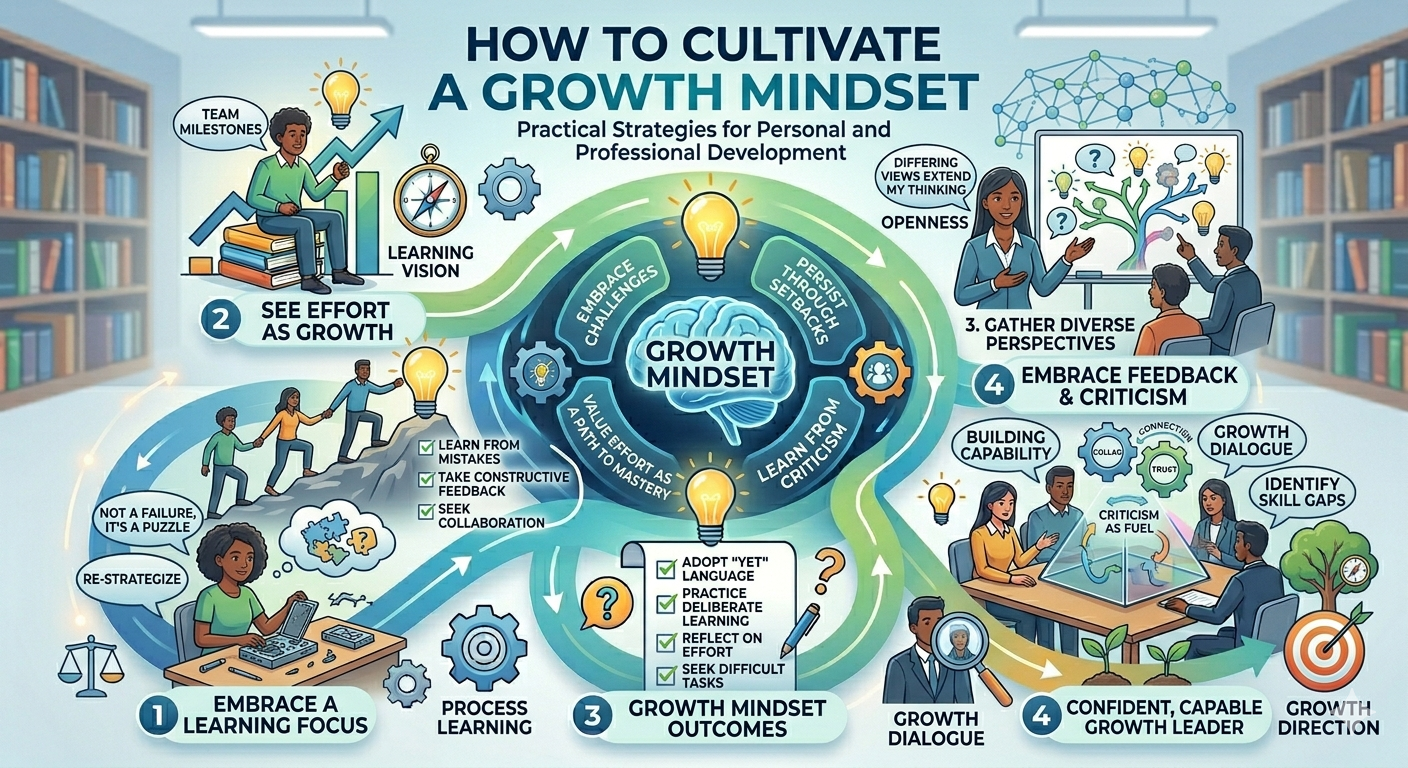

How to Cultivate a Growth Mindset Through Daily Practice
Learning how to cultivate a growth mindset begins with a fundamental change in interpretation: your current performance is evidence of what happened under a particular set of conditions, not final proof of your permanent potential. A poor result may show that your preparation, knowledge, strategy, confidence, environment, or available support was insufficient. It does not automatically prove that improvement is impossible.
The term “growth mindset” is closely associated with Stanford psychologist Carol Dweck, whose research has explored how beliefs about ability may influence motivation, self-regulation, challenge-seeking, persistence, and responses to setbacks. However, understanding the definition is only the beginning. The concept becomes valuable when it changes the way you set goals, respond to criticism, structure practice, and interpret mistakes.
One of the most common problems is turning growth mindset into a motivational slogan. Adding the word “yet” to a limiting statement can be useful, but only when it leads to a practical action. “I cannot do this yet” should be followed by questions such as: Which part do I not understand? What strategy have I already tried? Who could provide useful guidance? What is the smallest component I can practise next?
A growth mindset also requires realism. Some goals take years of training, and some outcomes are affected by conditions outside personal control. Development may be slow, uneven, or limited by health, time, resources, and opportunity. The purpose is not to guarantee success. It is to prevent temporary difficulty from becoming an unnecessarily permanent conclusion.
In my experience, the most effective approach is to treat mindset as a daily practice. Notice the thought, define the skill, select an action, review the evidence, and adjust the method. The following framework explains how to make that process practical in education, work, relationships, leadership, and personal development.
Understand Your Current Mindset Patterns
Before you can change your mindset, you need to recognize how it already operates. Fixed-mindset thoughts often appear automatically when a task threatens your confidence, social status, or sense of competence. They may be especially strong when you receive criticism, compare yourself with someone more experienced, make a visible error, or encounter a task that does not improve quickly.
The objective is not to eliminate every fixed thought. Most people move between fixed and growth-oriented responses depending on the subject and situation. Someone may confidently learn new software at work but feel permanently incapable when studying mathematics. Another person may believe that fitness improves through training while assuming that communication skills are simply part of personality.
Start by observing the language that appears during difficulty. Words such as “always,” “never,” “naturally,” “gifted,” and “just not me” often signal a permanent interpretation. The thought itself may not be a problem; the behaviour that follows is more important. A fixed interpretation can lead to avoidance, defensiveness, procrastination, excessive comparison, or perfectionism.
Self-awareness creates a pause between the event and your response. Instead of automatically withdrawing, you can ask what the situation actually demonstrates. Did the result reveal missing knowledge, weak preparation, an ineffective method, or insufficient practice? Could another person provide instruction? Is the task too large and in need of smaller steps?
This section is the foundation of all later growth mindset strategies. You cannot deliberately change a response that you do not notice. By identifying patterns without judging yourself, you create the possibility of choosing a more accurate and productive interpretation.
Identify Your Fixed-Mindset Triggers
A fixed-mindset trigger is a situation that activates defensive, limiting, or identity-based beliefs. Common triggers include receiving criticism, beginning as a novice, being observed while learning, meeting someone more skilled, failing publicly, or struggling with a task that was expected to be easy.
Pay attention to your first internal statement. It may sound like, “I am not talented,” “If I ask for help, people will think I am incapable,” or “This failure proves that I should stop.” Write these statements down without attempting to make them sound reasonable.
Next, separate the observable event from your interpretation. “My manager requested several revisions” is an event. “My manager thinks I am incompetent” is an interpretation. “I received a low test score” is an event. “I will never understand this subject” is an interpretation.
This distinction creates space for analysis. Ask which part of the task produced difficulty. Perhaps the instructions were unclear, the preparation was rushed, the foundation was weak, or the chosen method was unsuitable.
Trigger awareness becomes more useful when tracked over time. You may discover that your fixed reactions appear mainly around authority figures, public performance, competition, or subjects connected to past criticism. Recognizing the pattern allows you to prepare a more deliberate response before avoidance or defensiveness takes over.
Compare Fixed and Growth-Oriented Responses
The difference between fixed and growth thinking is often visible in the response to difficulty rather than the initial emotion. Both individuals may feel frustrated, embarrassed, or disappointed. The growth-oriented response simply looks for useful information and a realistic next action.
| Situation | Fixed-Mindset Response | Growth-Oriented Response |
|---|---|---|
| A difficult assignment | “I am not intelligent enough.” | “Which concept must I understand first?” |
| Critical feedback | “They do not respect my ability.” | “Which part is accurate, and how can I improve it?” |
| Someone performs better | “They have talent I will never have.” | “Which methods or habits can I learn from them?” |
| A failed attempt | “This proves I cannot do it.” | “What caused the result, and what should change?” |
| Slow progress | “My effort is pointless.” | “Am I using an effective strategy and measuring the right thing?” |
Use this table to examine responses, not to label yourself or other people permanently. A person can react defensively in one situation and constructively in another.
The growth-oriented column also avoids unrealistic positivity. It does not claim that every goal will be achieved. Instead, it replaces a broad identity judgment with a specific learning question.
With practice, these questions become easier to access during difficulty. The objective is not to remove emotion, but to prevent emotion from making the final decision about what you can learn.
Change the Language You Use About Ability
The language you use influences how you interpret difficulty and which actions feel available. Identity-based statements such as “I am bad at public speaking” or “I am not a creative person” make a current weakness sound permanent. Once a limitation becomes part of identity, practice may feel pointless or threatening.
Growth-oriented language is more precise. It describes the current performance, the missing skill, and the next possible action. Instead of saying, “I cannot lead,” you might say, “I need more practice delegating tasks and communicating expectations.” The revised statement does not pretend that the skill already exists. It simply turns a broad personal judgment into a trainable problem.
This shift matters because the brain responds differently to specific tasks than to vague identity threats. “Improve the structure of the next presentation” is manageable. “Become a naturally confident speaker” is unclear and emotionally demanding.
Growth-oriented language should also remain credible. Empty affirmations such as “I can achieve anything” may feel disconnected from reality. A more useful statement is, “I can improve this skill by practising one component, receiving feedback, and adjusting my method.”
The way you speak to others matters as well. Praise that focuses only on intelligence or natural talent can make performance feel like a test of identity. Process-focused feedback directs attention toward strategies, decisions, preparation, and improvement.
The goal is not to control every word perfectly. It is to notice when language closes the door on learning and replace it with wording that identifies a practical path forward.
Replace Identity Labels With Learning Statements
When you notice a fixed identity label, rewrite it as a description of your present skill level and the next capability you need to develop. This change makes the problem more specific, measurable, and actionable.
For example, “I am terrible at writing” can become, “I need a clearer system for outlining, drafting, and editing.” “I am not a leader” can become, “I need more experience making decisions, delegating responsibilities, and communicating expectations.” “I cannot learn languages” can become, “My current study method is not producing enough recall or speaking practice.”
These statements are not artificially positive. They acknowledge that the current result is unsatisfactory while refusing to treat it as permanent proof of identity. They also encourage useful questions. Which part should be practised first? What support is available? How will progress be measured?
The word “yet” can help when it prevents a premature conclusion. However, it should be followed by an action. “I cannot explain this concept yet” becomes meaningful when followed by, “I will review the foundation, attempt a simpler example, and ask for feedback.”
Over time, this language changes the focus from self-protection to problem-solving. You spend less energy proving whether you are capable and more energy identifying what effective learning would require.
Many of these practical techniques align with proven approaches to developing a growth mindset, especially when consistent practice is paired with reflection and feedback.
Praise Process Without Praising Effort Blindly
Effective encouragement focuses on the processes that contributed to improvement. This may include the strategy used, preparation completed, feedback applied, error corrected, or persistence shown after changing an ineffective method.
Process-focused praise can sound like, “You tested two approaches and found the more reliable one,” or “Your explanation improved because you reorganized the main points.” These statements identify behaviours that can be repeated.
By contrast, person-focused praise such as “You are naturally brilliant” may unintentionally make ability feel like an identity that must be protected. When a difficult task later threatens that identity, the person may avoid the challenge or hide mistakes.
Effort should not be praised blindly. If someone works hard without making progress, simply saying “keep trying” may communicate that frustration is the only available strategy. A stronger response acknowledges the effort and then asks whether the method, instruction, or level of difficulty needs to change.
Useful feedback combines recognition with direction: “You invested considerable time, but this approach is not producing the result. Let us identify where the process breaks down and test another method.”
The most responsible message is not that effort always wins. It is that skills can improve when effort is focused, informed by feedback, supported by resources, and adjusted when necessary.
Related Articles
Build Growth Mindset Habits Through Action
A growth mindset becomes stronger when it is supported by experience. Reading about learning and improvement may create temporary motivation, but repeated action provides more convincing evidence that skills can develop.
The most effective habits are small enough to repeat and specific enough to evaluate. Broad ambitions such as “become more confident” or “get better at work” provide direction but do not explain what to do today. A growth-oriented system converts those ambitions into observable behaviours.
Begin by selecting one skill rather than attempting to change every area of life at once. Break the skill into components, identify the weakest or most important part, and choose a practice activity that targets it. A person improving public speaking might practise opening statements, pacing, eye contact, or answering questions rather than repeatedly delivering complete presentations without feedback.
Growth mindset habits also require review. Practice without analysis can reinforce existing weaknesses. After each attempt, compare the result with clear criteria, identify one gap, and choose one adjustment for the next round.
Progress should be measured over an appropriate period. Daily performance can fluctuate because of sleep, stress, health, and environmental conditions. Weekly or monthly evidence often provides a more accurate view of development.
In my experience, a short written record is particularly useful. It prevents improvement from disappearing into memory and makes it easier to identify which strategies work.
The following two practices—process goals and deliberate practice—turn the idea of a growth mindset into a repeatable learning system. They shift attention away from proving talent and toward building capability.
Set Process Goals You Can Control
Outcome goals describe the result you hope to achieve, such as passing an examination, gaining a promotion, publishing an article, or completing a race. They provide direction, but they are not completely within your control. Other people, external conditions, competition, and timing may influence the final outcome.
Process goals describe actions that you can perform consistently. Examples include completing three focused study sessions each week, requesting feedback every Friday, practising a presentation opening five times, or reviewing every incorrect test answer.
Use a four-step method. First, define the skill you want to improve. Second, divide it into smaller components. Third, select one repeatable behaviour. Fourth, decide how you will track and review it.
For example, “become a confident presenter” is too broad. A process plan might include recording one five-minute explanation each week, reviewing pacing and filler words, and practising the introduction until it can be delivered without notes.
Process goals keep attention on behaviours that remain available even when outcomes are delayed. You may not receive the promotion immediately, but you can still improve decision-making, communication, and leadership experience.
They also make setbacks easier to analyse. Instead of concluding that the goal is impossible, you can ask whether the process was completed consistently and whether the chosen behaviour was effective.
Use Deliberate Practice and Feedback Loops
Deliberate practice targets a specific area of weakness, uses clear criteria, and includes feedback that guides correction. Repeating an entire task without examining the difficult component may create familiarity without meaningful improvement.
A simple feedback loop begins with a clearly defined attempt. Review the result using objective standards, identify one important gap, select a correction, repeat the task under similar conditions, and record what changed.
For example, a writer may focus on creating clearer introductions rather than repeatedly producing complete articles. A musician may isolate a difficult passage instead of playing the entire piece. A manager may practise giving concise instructions before attempting to improve every leadership skill at once.
The brain can adapt through experience and learning, a capacity commonly described as neuroplasticity. However, neuroplasticity should not be interpreted as proof that every skill can change quickly or without constraints. Development still depends on relevant practice, attention, instruction, rest, health, and opportunity.
Brief recovery periods can also support learning. NIH research has examined how short breaks may contribute to the consolidation of newly practised skills.
Maintain a short practice log containing the task, feedback, adjustment, and outcome. This record creates visible evidence of development and helps distinguish productive practice from simple repetition.
| Growth Mindset Habit | Why It Matters | Practical Daily Action | Expected Long-Term Benefit |
|---|---|---|---|
| Process-Focused Goals | Keeps attention on actions instead of outcomes | Set one measurable daily practice goal | Consistent skill improvement |
| Deliberate Practice | Targets weak areas systematically | Practice one challenging skill with feedback | Faster learning and mastery |
| Self-Reflection | Identifies strengths and improvement areas | Spend 5 minutes reviewing the day’s progress | Better self-awareness |
| Constructive Feedback | Highlights blind spots | Ask for one actionable suggestion each week | Continuous improvement |
| Positive Self-Talk | Reduces self-limiting beliefs | Replace negative thoughts with learning-focused language | Greater confidence and resilience |
| Progress Tracking | Makes improvement visible | Maintain a simple learning journal | Increased motivation and consistency |
Learn to Respond Productively to Setbacks
Setbacks are one of the clearest tests of mindset because they create emotional pressure to reach a quick conclusion. A disappointing result can easily become a statement about identity: “I failed, therefore I am a failure.” Growth-oriented thinking separates the result from the person.
Responding productively does not mean ignoring disappointment or immediately searching for a positive interpretation. Emotions often contain useful information. Frustration may reveal that a goal matters, while embarrassment may show that social evaluation feels threatening. The first step is to regulate the emotional response enough to examine the event accurately.
Once the initial intensity decreases, separate controllable factors from uncontrollable ones. Preparation, communication, strategy, and time management may be open to change. Market conditions, another person’s decision, illness, or unexpected disruption may not be controllable.
A growth mindset does not require endless persistence. Sometimes a method is unsuitable, a goal is no longer meaningful, or the cost of continuing is too high. Changing direction can represent learning rather than failure.
The objective is to identify the most useful lesson without creating a false story. Not every setback contains a dramatic hidden benefit. Some simply reveal that preparation was incomplete, expectations were unrealistic, or external conditions were unfavourable.
A productive response ends with a specific decision. This may involve trying again with a better strategy, requesting instruction, reducing the size of the task, allowing recovery, or selecting a different objective.
Conduct a Failure Review Without Self-Attack
A failure review is a structured analysis of what happened, why it happened, and what should change before the next attempt. It should be conducted after the strongest emotional reaction has passed, because shame and defensiveness can distort the interpretation.
Begin with neutral questions. What outcome did you expect? What actually happened? Which assumptions proved incorrect? Which factors were within your control? What information or preparation was missing? What should be repeated, stopped, or changed?
Separate responsibility from self-attack. Responsibility says, “My preparation did not include enough realistic practice, so I need a stronger plan.” Self-attack says, “The result proves I am incapable.” The first statement identifies a cause and a next action. The second closes the learning process.
Look for both strengths and weaknesses. A failed outcome may still contain parts that worked well. Preserving effective elements prevents you from rebuilding the entire approach unnecessarily.
A growth mindset also permits strategic withdrawal. If new information shows that the goal is unsuitable, unsafe, or no longer valuable, changing direction may be the most intelligent response.
The purpose of the review is not to transform every disappointment into inspiration. It is to produce the most accurate lesson available and convert that lesson into a practical decision.
Seek Feedback That Produces a Next Step
Feedback is most useful when it describes observable behaviour and leads to a specific correction. Vague praise may feel encouraging but provide no direction. Harsh criticism may identify a problem without explaining how improvement could occur.
Ask focused questions rather than requesting a general opinion. You might ask, “Which part of my explanation was least clear?” “Where did my reasoning become weak?” or “What should I practise before the next attempt?”
Evaluate the source as well as the message. Feedback deserves more weight when it comes from someone with relevant knowledge, refers to clear evidence, and connects to a realistic improvement. Not every comment should be treated equally.
Receiving feedback does not require agreeing with everything. Compare the comment with other evidence and look for patterns across multiple reliable sources. If several people identify the same issue, it deserves careful attention.
Avoid attempting to correct every weakness simultaneously. Select one or two changes that are likely to produce the greatest improvement, then test them in the next attempt.
Feedback becomes part of a growth mindset when it closes the distance between current performance and the next practical action. Its purpose is not to judge your worth. It is to provide information that makes the following attempt more informed.
Apply a Growth Mindset in Everyday Life
Growth mindset is often discussed in education, but its practical value extends to professional development, relationships, health habits, leadership, creativity, and personal goals. The specific skill changes, but the underlying process remains similar: define what can be learned, practise deliberately, request useful feedback, and adjust your approach.
In professional settings, growth-oriented thinking can reduce the tendency to interpret every challenge as a test of competence. A new responsibility becomes an opportunity to identify missing skills rather than proof that you are unqualified. However, organizations must provide training, resources, fair evaluation, and psychological safety. Employees should not be expected to solve structural problems through attitude alone.
In relationships, a growth mindset helps people view communication, emotional regulation, and conflict management as skills rather than fixed personality traits. This does not mean every relationship can or should continue. It means that patterns can be described specifically and addressed where change is appropriate.
Health and lifestyle goals also benefit from this approach. Missing one workout or abandoning a habit for several days does not prove a lack of discipline. It provides information about the design of the routine, environmental barriers, and the size of the goal.
The most important principle is to avoid turning growth mindset into self-blame. If improvement is slow, examine instruction, support, resources, workload, and environmental conditions—not only motivation.
The following applications show how growth-oriented habits can support learning, work, relationships, and personal development while remaining realistic.
| Life Area | Common Fixed Mindset | Growth Mindset Approach | Key Benefit |
|---|---|---|---|
| Education | “I’m not good at this subject.” | Focus on learning strategies and regular practice | Better academic performance |
| Career | “I’m not leadership material.” | Develop leadership skills through feedback and experience | Professional growth |
| Health & Fitness | “I’ll never stay consistent.” | Build small sustainable habits over time | Long-term healthy lifestyle |
| Relationships | “I’m just a poor communicator.” | Practice active listening and constructive conversations | Stronger relationships |
| Personal Development | “I can’t learn new skills.” | Break learning into manageable steps | Lifelong learning mindset |
| Creative Skills | “I’m not naturally talented.” | Improve through deliberate practice and experimentation | Higher creativity and confidence |
Use Growth Mindset at Work and in Learning
At work, replace broad identity concerns with specific capability gaps. Instead of saying, “I am not management material,” identify the skills involved: delegation, decision-making, conflict resolution, planning, or communication. Each can be practised, observed, and supported separately.
Employees can request stretch assignments that remain challenging but achievable. After completing them, they can review what worked, where guidance was needed, and which skill should be developed next.
Managers play an important role. They can create a growth-oriented environment by providing actionable feedback, allowing appropriate revision, offering training, and recognizing improvement. Telling employees to “have a growth mindset” should never replace adequate resources or fair working conditions.
Students can apply the concept by reviewing errors, practising retrieval, attending office hours, asking questions early, and changing ineffective study methods. A poor grade should lead to an analysis of preparation, understanding, and strategy rather than a permanent conclusion about intelligence.
Large-scale research suggests that growth mindset interventions do not produce identical effects in every environment. Results may depend on prior achievement, social context, teaching quality, and whether the surrounding culture genuinely supports challenge-seeking and improvement.
In both education and work, growth mindset is strongest when beliefs are supported by real opportunities to learn.
Use Growth Mindset in Relationships and Personal Goals
In relationships, growth-oriented thinking treats communication, listening, emotional regulation, and conflict management as developable skills. Instead of saying, “I am a bad communicator,” describe the behaviour more precisely: “I interrupt when I feel defensive,” or “I delay difficult conversations until frustration builds.”
Specific descriptions make change possible. You can practise pausing before responding, summarizing what another person said, or preparing for a difficult conversation in advance.
A growth mindset does not mean accepting harmful behaviour or believing every relationship must be repaired. Boundaries, compatibility, safety, and mutual willingness still matter. The purpose is to avoid treating every pattern as permanently fixed when change is both possible and appropriate.
For personal goals, examine the system after a setback. If a habit repeatedly fails, ask whether the action is too large, the cue is unclear, the environment creates friction, or the reward is too distant.
Self-compassion is important because constant self-criticism can make mistakes feel dangerous. Accountability and kindness can exist together. You can acknowledge the consequences of a behaviour, make a repair, and practise a better response without describing yourself as permanently flawed.
Personal growth becomes sustainable when improvement is measured across weeks or months rather than judged through one difficult day.
Quick Answer About How to Cultivate a Growth Mindset
Learning how to cultivate a growth mindset begins with treating abilities as skills that can improve through effective practice, useful strategies, constructive feedback, and appropriate support. When a fixed-mindset thought appears—such as “I am simply not good at this”—replace the permanent judgment with a specific question: “Which skill, strategy, resource, or form of help could move me forward?”
A growth mindset does not mean believing that effort guarantees success. It also does not require constant positivity. Instead, it encourages you to choose manageable challenges, create process-focused goals, examine mistakes without attacking your identity, and adjust your methods when the first approach does not work.
The practical process is simple but requires repetition. Notice your automatic response, separate facts from interpretations, identify the skill involved, choose one small action, request feedback, and review what changed. Over time, these habits provide evidence that current performance is not the same as permanent potential.
A growth mindset should also remain realistic. Personal improvement is influenced by instruction, health, time, resources, opportunities, and social conditions. Mindset is most useful when it helps you act on what you can influence while recognizing when external support or structural change is needed.
What Is a Growth Mindset?
A growth mindset is the belief that intellectual abilities, talents, and practical skills can be developed through learning, experience, effective practice, and support. Stanford teaching resources contrast this belief with a fixed mindset, in which intelligence or ability is viewed as largely permanent and difficult to change.
This distinction does not mean that people begin with identical abilities or will achieve identical outcomes. Individuals differ in health, education, opportunity, resources, responsibilities, prior knowledge, and natural preferences. A growth mindset simply maintains that meaningful development is possible within those realities.
The concept becomes useful when it changes behaviour. Someone with a growth-oriented response is more likely to ask for clarification, try a new strategy, practise a weak component, or review an error. The person may still feel disappointed or uncertain, but those emotions do not automatically become proof of permanent inability.
Mindsets can also vary by subject. A person may believe that physical fitness improves through training while assuming that writing, mathematics, leadership, or creativity is fixed. Developing a growth mindset therefore requires identifying beliefs within specific areas rather than attempting to become a permanently “growth-minded person.”
What a Growth Mindset Is Not
A growth mindset is not blind optimism, constant confidence, or the denial of real limitations. You can feel discouraged, anxious, or disappointed while still responding constructively. The essential question is not whether you feel positive; it is whether you remain willing to learn, adapt, and seek appropriate support.
It is also incorrect to reduce growth mindset to “try harder.” Effort matters only when it is connected to an effective strategy, relevant instruction, useful feedback, and sufficient time. Repeating an ineffective method without analysing the result is persistence without learning.
Research on growth mindset interventions is more complicated than many popular summaries suggest. Some meta-analyses report modest benefits that vary according to the participants, environment, and quality of implementation. Other analyses question whether effects on academic achievement are consistently meaningful. These findings do not make the concept useless, but they do discourage exaggerated promises.
Mindset is one influence among many. Access to education, psychological safety, financial stability, health, discrimination, teaching quality, and available resources also affect performance. A responsible growth mindset helps a person identify what can be improved while acknowledging external barriers. It should complement good instruction, fair opportunities, and practical support—not replace them.
Frequently Asked Questions About How to Cultivate a Growth Mindset
Questions about how to cultivate a growth mindset often focus on whether fixed beliefs can change, how long the process takes, and whether the concept is supported by research. These questions are important because growth mindset is sometimes presented too simply.
Mindset change is not a one-time transformation. A person may become more growth-oriented in one area while continuing to react defensively in another. Stress, public evaluation, comparison, or past experiences can cause fixed-mindset responses to return.
It is also important to distinguish mindset from performance. Believing that improvement is possible may encourage more effective behaviour, but belief alone does not create knowledge, resources, instruction, or opportunity. Growth mindset should support practical action rather than replace it.
The concept is most useful when it leads to better questions. What skill is missing? What strategy has not been tested? Which feedback source is reliable? What environmental condition needs to change? What level of support is required?
The following answers address common misunderstandings while providing practical guidance for students, employees, parents, teachers, leaders, and adults pursuing personal development.
Can a Fixed Mindset Be Changed?
Yes. A fixed mindset is a belief pattern rather than a permanent personality type. Change begins by noticing when difficulty produces broad conclusions such as “I will never understand this” or “I am not the kind of person who can do this.”
Replace the identity judgment with a specific learning question. Ask which skill is weak, what method has already been attempted, and where better guidance may be available.
Change becomes more believable when it is supported by evidence. Choose one manageable skill, practise it consistently, request feedback, and record small improvements. The experience of learning provides stronger proof than positive statements alone.
Fixed reactions may return under stress, comparison, or criticism. This does not mean the process failed. It means mindset requires repeated practice.
The goal is not to eliminate every limiting thought. It is to notice the thought early enough to prevent it from controlling the next action.
How Long Does It Take to Develop a Growth Mindset?
There is no universal timeline because mindset patterns vary by person, subject, and environment. You may reframe one belief in a single conversation while continuing to experience fixed reactions in another area for months.
A better approach is to measure behaviour rather than waiting to feel permanently transformed. Track whether you attempt manageable challenges, ask for feedback, review mistakes, and adjust strategies more often than before.
Stress can temporarily reactivate old patterns. Someone who normally responds constructively may become defensive during public criticism or an important examination. This does not erase earlier progress.
Review your responses across several weeks. Notice whether recovery from setbacks becomes faster and whether identity-based conclusions become more specific learning questions.
Growth mindset is best understood as an ongoing practice rather than a final state. The objective is gradual improvement in how you interpret difficulty and choose your next action.
Is Growth Mindset the Same as Positive Thinking?
No. Positive thinking usually emphasizes favourable expectations, optimism, or focusing on desirable outcomes. Growth mindset emphasizes the possibility of development through practice, strategy, feedback, and support.
A growth-oriented response can include disappointment, concern, or uncertainty. You do not need to pretend that a setback feels positive. You only need to remain willing to examine what happened and identify a useful next step.
Positive statements can be helpful when they are realistic. “I can improve this skill through practice” is more useful than “Everything will work out perfectly.”
Growth mindset also recognizes external barriers. It does not claim that attitude alone can overcome poor instruction, discrimination, illness, or lack of resources.
The central question is not, “How can I feel more positive?” It is, “What can I learn, practise, request, or change next?”
Does Effort Always Lead to Improvement?
No. Effort can produce little progress when the strategy is unsuitable, the task is misunderstood, the feedback is weak, or practice repeatedly reinforces the same mistake.
Growth-oriented effort is flexible. It includes checking results, seeking instruction, changing methods, and focusing on the component that needs improvement.
For example, spending more hours rereading notes may not improve recall. Retrieval practice, testing, and feedback may produce better learning. The issue is not the willingness to work; it is whether the work targets the correct process.
Sometimes the most productive decision is to pause, rest, seek expert guidance, or choose a different goal. Persistence should not become an excuse to ignore health, cost, or new information.
Effort matters, but improvement usually depends on the combination of effort, effective strategy, quality feedback, support, and appropriate conditions.
How Can Teachers Encourage a Growth Mindset?
Teachers can encourage a growth mindset by providing process-focused feedback, normalizing revision, explaining the purpose of mistakes, and giving students genuine opportunities to improve their work.
Challenges should be demanding enough to promote learning but supported with clear instruction, examples, and feedback. Simply telling a struggling student to “keep trying” is unlikely to help when the student does not understand the method.
Teachers can also model learning by discussing how their own understanding developed and how experts revise their work. Assessment practices can include corrections, drafts, or reflection when appropriate.
The broader environment matters. Research suggests that brief mindset messages may have limited value when students lack instructional support, resources, or a classroom culture that welcomes challenge.
Growth mindset should therefore be embedded in teaching practice rather than presented only as a motivational poster or slogan.
Does Growth Mindset Research Prove Better Performance?
The evidence does not show that growth mindset automatically produces better performance for every person in every setting. Some studies and meta-analyses report small benefits, particularly for certain groups or well-designed interventions. Other analyses question whether effects on academic achievement are consistent or practically significant.
These differences may reflect variation in study design, implementation quality, participant characteristics, and educational environment.
The most responsible conclusion is that growth mindset can be a useful motivational and learning framework, but it is not a guaranteed performance intervention.
It should be combined with strong instruction, appropriate practice, useful feedback, material resources, and realistic opportunities to improve.
Avoid claims that one short exercise will transform achievement. The concept is most valuable when it supports better behaviour over time rather than when it is marketed as a universal solution.
Conclusion
Understanding how to cultivate a growth mindset requires moving beyond motivational language and changing the way you respond to difficulty. A growth-oriented person still experiences frustration, comparison, anxiety, and disappointment. The difference lies in what happens next.
The process begins with self-awareness. Notice the situations that trigger permanent judgments about ability. Separate the observable event from the interpretation, and define the specific skill involved.
Next, change the language you use. Replace identity labels with learning statements that point toward action. Create process goals that focus on controllable behaviours, and use deliberate practice to target specific weaknesses.
Feedback should be treated as information rather than a verdict on personal worth. Ask focused questions, evaluate the source, select one useful correction, and test it in the next attempt.
Setbacks should be reviewed carefully. Take responsibility for controllable factors without turning responsibility into shame. Preserve what worked, change what did not, and recognize when a different goal or additional support is appropriate.
A growth mindset should remain realistic. It cannot replace quality teaching, fair opportunities, health support, adequate resources, or structural change. Its role is to help you act more effectively within the conditions you can influence.
The strongest evidence of mindset development is not constant confidence. It is a growing ability to remain curious, specific, and adaptable when progress becomes difficult.
Focus on Learning, Strategy, and Support
A growth mindset does not promise unlimited ability or guaranteed success. Its value lies in keeping improvement possible long enough for meaningful learning to occur.
Effort should be connected to strategy. Strategy should be tested through feedback. Feedback should lead to one manageable action. Support should be requested when progress requires knowledge, accommodations, tools, time, or guidance that you do not yet have.
This sequence prevents growth mindset from becoming self-blame. If progress remains slow, the question should not always be, “Why am I not trying hard enough?” It may be necessary to examine instruction, environment, workload, health, or access to resources.
The research literature also supports realistic expectations. Mindset may influence how people interpret challenges, but it operates within educational, professional, social, and economic systems.
A useful question is, “What does this result teach me about the next attempt?” That question shifts attention away from identity and toward information.
When learning, strategy, and support are considered together, growth mindset becomes a practical framework for improvement rather than a motivational slogan.
Start With One Seven-Day Experiment
Choose one skill that matters to you and run a seven-day growth mindset experiment. Keep the goal small enough to observe clearly.
On day one, define the skill and describe your current difficulty without using an identity label. On day two, identify the fixed-mindset thought that most often appears around the task.
On day three, create one process goal. This may involve practising for 20 minutes, reviewing one error, or asking one specific question.
On days four and five, complete the practice and record what happened. Note the strategy used, the difficulty experienced, and any change in performance.
On day six, request targeted feedback from a knowledgeable person or compare your work with clear criteria.
On day seven, review the evidence. Identify what improved, what remained difficult, and which strategy should be adjusted during the next cycle.
Do not judge the experiment only by the final outcome. Increased awareness, stronger questions, better feedback, and a willingness to continue are also meaningful results.
This is the practical foundation of how to cultivate a growth mindset: not proving that you can achieve everything, but learning how to improve what matters through more accurate thinking and better action.
Building small, repeatable growth mindset habits over time can make it easier to turn daily practice into lasting behavioural change.