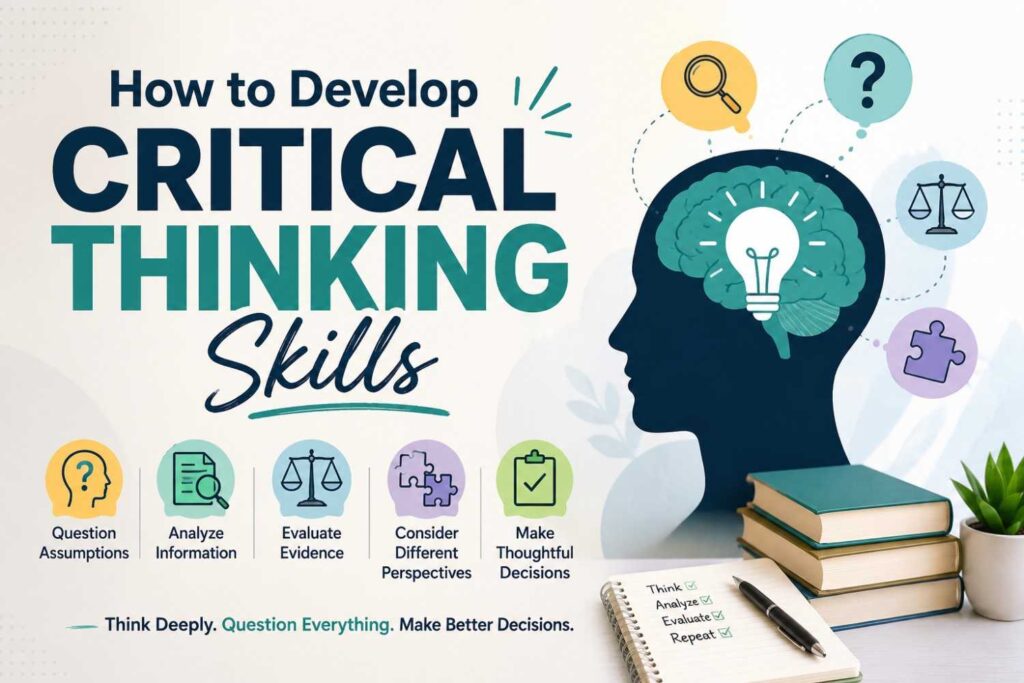
A Complete Step-by-Step Guide
Critical thinking has become one of the most important skills in today’s fast-changing and information-heavy world. With constant exposure to news, social media, opinions, and data, it is easy to feel overwhelmed or misled. Critical thinking helps you filter information, evaluate its credibility, and form balanced judgments based on logic rather than emotion or assumption.
Developing this skill is not limited to academics—it directly impacts your career, relationships, and daily decision-making. People who think critically are better problem-solvers, more independent in their opinions, and less likely to be influenced by misinformation. It is a skill that improves gradually through practice, awareness, and consistent mental discipline.
This guide focuses on practical strategies rather than theory alone. You will learn structured techniques, real-life applications, and simple daily habits that strengthen your ability to analyze situations from multiple perspectives. These methods are designed to help you think more clearly, question information effectively, and make more rational decisions in both personal and professional life
Whether you are a student aiming for academic success, a professional improving workplace performance, or simply someone who wants to think more clearly, developing critical thinking skills will significantly enhance your ability to understand complex situations and make smarter choices over time.
What Are Critical Thinking Skills?
Critical thinking skills refer to the mental ability to analyze information objectively, question assumptions, and make decisions based on logic rather than emotion. It is not just about “thinking harder,” but about thinking in a structured and disciplined way. A person with strong critical thinking skills does not immediately accept information as true; instead, they evaluate it, compare it, and verify its accuracy before forming a conclusion.
In real life, these skills are used when solving problems, making decisions, or evaluating arguments. For example, when reading a news article, a critical thinker checks the source, considers bias, and compares it with other information before believing it. Similarly, in workplace situations, critical thinking helps in identifying risks, improving processes, and making strategic decisions.
Another important aspect is that critical thinking is closely linked with cognitive development. It involves memory, reasoning, attention, and interpretation. These mental functions work together to help individuals process information more effectively. Over time, people who regularly practice critical thinking become more independent thinkers and less likely to be influenced by misinformation or emotional bias.
Ultimately, understanding what critical thinking skills are is the first step toward improving them. Once you recognize how thinking works, you can begin training your mind to become more analytical, logical, and reflective in everyday situations.
Understanding Analytical Thinking vs Critical Thinking
Analytical thinking and critical thinking are often used interchangeably, but they serve slightly different purposes. Analytical thinking focuses on breaking down complex information into smaller parts to understand how something works. For example, a data analyst studying trends in sales is primarily using analytical thinking to identify patterns and relationships within numbers.
Critical thinking, on the other hand, goes one step further. It not only involves analyzing information but also evaluating its accuracy, relevance, and reliability. A critical thinker asks questions like: Is this information trustworthy? What evidence supports it? Are there alternative explanations?
Both skills complement each other. Analytical thinking helps you understand structure, while critical thinking helps you judge meaning and validity. Together, they form the foundation of strong reasoning ability. In professional environments, especially in fields like business, healthcare, and education, both skills are essential for effective decision-making and problem-solving.
Developing both abilities allows individuals to approach challenges more systematically, avoid errors in judgment, and create more reliable solutions. This combination is what makes critical thinking a highly valued skill across industries.
Role of Logical Reasoning in Thinking Skills
Logical reasoning is the backbone of critical thinking. It is the ability to connect ideas in a structured way to reach valid conclusions. Without logical reasoning, thinking becomes fragmented and influenced by emotions or assumptions rather than facts.
For example, if someone believes “all online courses are effective because one course was helpful,” logical reasoning helps challenge that assumption by asking whether one example is enough to justify a general conclusion. This process prevents faulty thinking patterns such as overgeneralization or confirmation bias.
Logical reasoning also plays a key role in decision-making. When faced with multiple options, a logical thinker evaluates each choice based on evidence, potential outcomes, and risks. This structured approach reduces impulsive decisions and improves long-term results.
Strengthening logical reasoning requires consistent practice, such as solving puzzles, engaging in debates, or analyzing real-life scenarios. Over time, it trains the brain to follow structured patterns instead of emotional reactions, which significantly improves overall thinking quality.
Cognitive Processes Behind Critical Thinking
Critical thinking is deeply connected to cognitive processes such as attention, memory, perception, and reasoning. These processes determine how we interpret and respond to information in everyday life. When these cognitive functions are well-developed, individuals can process complex ideas more efficiently and accurately.
For instance, attention helps focus on relevant information while ignoring distractions. Memory allows us to recall past knowledge and apply it to new situations. Perception helps interpret what we observe, and reasoning allows us to draw conclusions based on that interpretation.
Cognitive psychology suggests that these processes can be trained through practice and repetition. Activities like reading complex material, engaging in discussions, and solving problems regularly strengthen neural connections in the brain. This leads to improved mental clarity and faster decision-making.
Understanding these cognitive foundations helps individuals realize that critical thinking is not a fixed trait but a skill that can be developed. With consistent effort, anyone can improve how their brain processes information and makes decisions.
Why Critical Thinking Skills Matter in Daily Life
Critical thinking plays a crucial role in almost every aspect of life, from personal decisions to professional success. In today’s fast-paced world, people are constantly exposed to large amounts of information, opinions, and influences. Without critical thinking, it becomes easy to make poor decisions or accept incorrect information.
In daily life, critical thinking helps individuals make more informed choices. Whether it is choosing a career path, managing finances, or solving family issues, the ability to evaluate options logically leads to better outcomes. It reduces emotional decision-making and encourages a more balanced perspective.
Professionally, critical thinking is equally important. Employers value employees who can analyze problems, identify solutions, and think independently. It improves productivity, teamwork, and leadership skills. In many industries, critical thinking is directly linked to innovation and efficiency.
On a broader level, critical thinking also improves communication. People who think critically are better at expressing their ideas clearly and understanding different perspectives. This leads to healthier discussions and fewer misunderstandings.
Overall, developing critical thinking skills is not just an academic exercise—it is a life skill that influences success, relationships, and personal growth.
Better Decision Making Skills
Decision-making is one of the most practical applications of critical thinking. Every day, people make decisions—some small and some life-changing. Critical thinking improves this process by introducing structure and logic into choices.
Instead of relying on instinct or emotion alone, critical thinkers evaluate all available options. They consider short-term and long-term consequences, compare alternatives, and assess risks before making a final decision. This reduces the likelihood of regret or error.
For example, when choosing a job, a critical thinker will not only consider salary but also work environment, career growth, and stability. This deeper evaluation leads to more satisfying long-term decisions.
Over time, strong decision-making skills build confidence and reduce stress because individuals trust their ability to choose wisely.
Improved Problem-Solving Ability
Problem-solving is a natural extension of critical thinking. When faced with challenges, critical thinkers do not panic or react impulsively. Instead, they break problems into smaller parts and analyze each component individually.
This structured approach makes complex problems easier to manage. It allows individuals to identify root causes instead of just addressing symptoms. For example, in a workplace issue like declining productivity, a critical thinker would examine workflow, communication, and resources rather than blaming individuals immediately.
This method leads to more effective and sustainable solutions. Over time, strong problem-solving ability becomes a key advantage in both personal and professional life.
Enhanced Communication and Argument Skills
Critical thinking also improves communication skills by encouraging clarity, logic, and evidence-based reasoning. When people think critically, they are better able to structure their thoughts before expressing them.
This results in more effective conversations, stronger arguments, and better understanding during discussions. Instead of reacting emotionally during disagreements, critical thinkers respond with logic and reasoning.
They also become better listeners, which helps them understand different viewpoints before forming judgments. This leads to more respectful and productive communication in both personal and professional relationships.
Core Components of Critical Thinking
Critical thinking is built on several core components that work together to create structured thinking. These include analysis, evaluation, inference, and reflection. Each component plays a unique role in how we process information and make decisions.
Understanding these components helps individuals identify which areas they need to improve. For example, someone may be good at analyzing information but struggle with evaluating its accuracy. Recognizing this imbalance is the first step toward improvement.
These components are not separate skills but interconnected parts of a single thinking system. Strengthening one area often improves others as well. Over time, consistent practice helps develop a balanced and effective thinking process that enhances both personal and professional decision-making abilities.
| Core Area | Key Focus | Practical Application | Expected Outcome |
|---|---|---|---|
| Analytical Thinking | Breaking down complex information into smaller parts | Reviewing data, identifying patterns, separating facts from assumptions | Better understanding of complex problems and situations |
| Logical Reasoning | Structuring thoughts in a step-by-step manner | Evaluating arguments, checking consistency in ideas | Improved decision-making accuracy and clarity |
| Evaluation Skills | Assessing credibility and reliability of information | Checking sources, comparing multiple viewpoints | Reduced misinformation influence and stronger judgment |
| Reflection Practice | Reviewing past thoughts and decisions | Journaling daily experiences and decisions | Increased self-awareness and improved future decisions |
| Questioning Ability | Challenging assumptions and ideas deeply | Using “why,” “how,” and “what if” questions | Deeper understanding and reduced surface-level thinking |
| Cognitive Flexibility | Ability to shift perspectives | Considering alternative solutions and viewpoints | More adaptable and balanced thinking approach |
Analysis and Interpretation
Analysis involves breaking down information into smaller, understandable parts. It allows individuals to see how different elements relate to each other. Interpretation goes one step further by assigning meaning to those elements.
For example, when reading a report, analysis helps identify key data points, while interpretation helps understand what those data points mean in context. Together, they form the foundation of structured thinking.
Developing this skill requires practice in observing details, organizing information, and identifying patterns. Over time, individuals become more efficient at understanding complex situations.
Evaluation of Evidence and Arguments
Evaluation is the process of judging whether information is reliable and relevant. It involves questioning the source, checking facts, and identifying bias or assumptions.
This step is crucial because not all information is accurate. In today’s digital world, misinformation spreads quickly, making evaluation an essential skill.
Strong evaluators compare multiple sources and look for evidence before forming conclusions. This reduces errors in judgment and improves decision quality.
Reflection and Self-Awareness
Reflection involves thinking about your own thinking process. It helps identify biases, mistakes, and areas for improvement.
Self-awareness is essential for growth because it allows individuals to recognize patterns in their decision-making. By reflecting on past actions, people can learn what worked and what didn’t.
This continuous feedback loop strengthens critical thinking over time and encourages lifelong learning.
How to Develop Critical Thinking Skills Effectively
Developing critical thinking skills is a gradual process that requires intentional effort and consistent practice. One of the most effective methods is to actively question the information you encounter instead of accepting it at face value. This habit helps you slow down your thinking process and evaluate information more logically.
Structured learning techniques also play an important role. Methods like Socratic questioning and Bloom’s Taxonomy help you move from basic understanding to deeper analysis and evaluation. These frameworks train your mind to think beyond memorization and focus on reasoning and connections between ideas.
Another important approach is exposing yourself to diverse perspectives. When you read different viewpoints or engage in discussions, you challenge your existing beliefs and improve mental flexibility. This helps reduce bias and strengthens logical reasoning.
Reflection is equally important. When you regularly review your thoughts and decisions, you begin to notice patterns in your thinking. This awareness allows you to correct mistakes and improve decision-making over time.
Overall, developing critical thinking requires patience and consistency. Small daily practices build strong long-term cognitive skills that improve both personal and professional decision-making.
Ask Better Questions (Socratic Method)
The Socratic Method is a powerful technique for developing critical thinking skills. It focuses on asking structured, continuous questions that challenge assumptions and explore deeper meaning rather than accepting information immediately.
Instead of asking whether something is true, Socratic questioning encourages deeper inquiry such as why it is true, what evidence supports it, and whether alternative explanations exist. This approach forces the mind to slow down and analyze information more carefully.
In real-life situations, this method can be used in education, workplace discussions, and personal decisions. It improves intellectual curiosity and reduces cognitive bias by encouraging deeper understanding of complex issues.
Practice Structured Thinking Frameworks (Bloom’s Taxonomy)
Bloom’s Taxonomy is a framework that organizes thinking into different levels, starting from basic knowledge and progressing to higher-order thinking such as analysis, evaluation, and creation.
The levels include remembering, understanding, applying, analyzing, evaluating, and creating. Each stage represents a deeper level of cognitive engagement, helping individuals move beyond simple memorization toward meaningful learning.
Applying this framework in daily learning improves problem-solving skills and encourages active engagement with information. Instead of passively absorbing content, learners begin to question, analyze, and apply knowledge in practical situations.
Develop the Habit of Reflection
Reflection involves reviewing your thoughts, decisions, and actions to understand what worked and what did not. It is a powerful tool for improving critical thinking skills over time.
By reflecting on your decisions, you can identify emotional influences, biases, and patterns in your thinking. This awareness helps improve future decision-making and reduces repeated mistakes.
Journaling is one of the most effective reflection techniques. Writing about your daily decisions and reasoning helps organize thoughts and improve clarity. Over time, this builds stronger self-awareness and structured thinking skills.
Practical Exercises to Improve Critical Thinking
Practical exercises are essential for developing strong critical thinking skills. They help you apply theoretical knowledge in real-life situations and strengthen your ability to analyze and evaluate information.
One of the simplest exercises is journaling your thoughts daily. Writing forces you to organize your thinking and identify patterns or biases. Another effective exercise is solving real-life problems such as budgeting, planning tasks, or analyzing decisions.
Evaluating information critically is also important. When reading news or social media content, always question the source, evidence, and intent behind the information. This helps develop analytical awareness.
Engaging in discussions and debates exposes you to different perspectives and improves reasoning skills. Over time, these exercises shift your thinking from reactive to analytical.
Journaling and Thought Analysis
Journaling helps externalize thoughts, making them easier to analyze. Writing about your decisions allows you to understand your reasoning process more clearly.
You can ask yourself questions such as what happened, why you thought a certain way, and whether your reasoning was logical or emotional. This improves self-awareness and reduces cognitive bias.
Over time, journaling strengthens structured thinking and helps reduce mental clutter, leading to clearer decision-making.
Problem-Solving Scenarios
Problem-solving scenarios help apply critical thinking in practical situations. These may include managing finances, planning projects, or resolving workplace challenges.
Breaking problems into smaller parts and analyzing each component logically helps identify better solutions. Asking questions like what the root cause is and what possible outcomes exist improves decision quality.
Evaluate News and Information Critically
In the digital age, misinformation is widespread. Evaluating news critically is essential for developing strong analytical thinking skills.
Always check the source, verify evidence, and compare multiple viewpoints before accepting information. This reduces bias and improves decision-making accuracy.
Common Mistakes That Limit Critical Thinking
Many people struggle with critical thinking not because they lack intelligence, but because certain mental habits interfere with clear reasoning. These habits often develop over time and operate automatically, making it difficult to notice when judgment is being influenced. As a result, decisions may become less objective and more biased, even when individuals believe they are thinking logically.
Understanding these common mistakes is an important step toward improving thinking ability. Once you become aware of these patterns, you can actively correct them and develop a more balanced, structured, and rational approach to decision-making in everyday life.
Emotional Decision Making
Emotional decision-making happens when choices are driven mainly by feelings such as fear, excitement, anger, or stress rather than logical analysis. While emotions are a natural and important part of human thinking, relying on them too heavily can distort judgment and lead to impulsive decisions.
Critical thinkers learn to pause before reacting and separate emotional responses from factual evaluation. By taking a moment to analyze the situation logically, they are able to reduce impulsive behavior and make more stable, well-reasoned decisions that lead to better long-term outcomes.
Confirmation Bias
Confirmation bias is the tendency to search for, interpret, and remember information in a way that supports existing beliefs while ignoring or dismissing opposing viewpoints. This creates a narrow perspective and prevents individuals from fully understanding complex issues.
To overcome this bias, it is important to intentionally seek out alternative opinions, challenge personal assumptions, and evaluate evidence from multiple sources. This practice broadens perspective and strengthens the ability to think critically and objectively.
Overconfidence in Opinions
Overconfidence occurs when individuals place too much trust in their own knowledge or judgments, assuming their opinions are always correct. This mindset can limit personal growth and reduce openness to new information or constructive feedback.
Critical thinkers remain flexible and understand that knowledge is constantly evolving. They are willing to revise their opinions when presented with strong evidence, which allows them to grow intellectually and make more accurate decisions over time.
Critical Thinking in Education, Work, and Daily Life
Critical thinking plays a vital role in almost every area of life because it shapes how individuals process information, evaluate situations, and make decisions. Whether in education, professional environments, or daily personal choices, the ability to think clearly and logically leads to better outcomes and fewer mistakes. It helps people move beyond surface-level understanding and develop deeper insight into complex situations.
In a world filled with constant information and rapid change, critical thinking is no longer optional—it is a necessary life skill. It improves independence, strengthens confidence in decision-making, and allows individuals to adapt more effectively to new challenges and environments.
| Life Area | Thinking Skill Used | Example Situation | Result of Critical Thinking |
|---|---|---|---|
| Education | Analytical + Evaluative Thinking | Understanding concepts instead of memorizing | Deeper learning and better academic performance |
| Workplace | Problem-Solving + Logical Reasoning | Handling workflow issues or decision-making | Higher productivity and better outcomes |
| Personal Life | Reflective Thinking | Choosing between financial or life decisions | Reduced mistakes and improved life satisfaction |
| Media Consumption | Evaluation Skills | Reading news or social media content | Protection from misinformation and bias |
| Communication | Logical Expression | Discussing or debating ideas | Clear arguments and better understanding |
| Financial Decisions | Analytical Thinking | Budgeting or investing choices | Smarter financial management and stability |
In Education and Learning
In education, critical thinking helps students go beyond simple memorization and focus on understanding concepts at a deeper level. Instead of just remembering facts, students learn how to analyze information, compare ideas, and apply knowledge to real-world situations. This improves academic performance and long-term learning retention.
It also encourages curiosity and independent thinking, allowing students to ask better questions and explore subjects more thoroughly. As a result, learners become more engaged, self-motivated, and capable of solving complex problems rather than relying solely on instructions or predefined answers.
In the Workplace
In professional environments, critical thinking is essential for improving efficiency, decision-making, and innovation. Employees who think critically are better at identifying problems, evaluating solutions, and making informed choices that benefit both their team and organization.
It also supports creativity and adaptability in fast-changing industries. By analyzing situations logically and considering multiple perspectives, professionals can develop better strategies, avoid costly mistakes, and contribute more effectively to workplace success.
In Everyday Life Decisions
In daily life, critical thinking helps individuals make more balanced and rational decisions in areas such as finances, relationships, health, and personal goals. Instead of reacting impulsively, people learn to evaluate options carefully before taking action.
This skill also helps reduce the influence of misinformation, emotional pressure, and external bias. As a result, individuals become more confident in their choices and better equipped to handle everyday challenges with clarity and control.
Tools and Techniques to Strengthen Thinking Skills
Improving critical thinking requires consistent practice, and using structured tools can make the process much more effective. These tools help organize thoughts, evaluate situations from different angles, and train the brain to think more logically. When applied regularly, they gradually improve clarity, reasoning ability, and decision-making skills in both academic and real-life situations.
Instead of relying only on intuition, these techniques encourage a more systematic approach to thinking. They allow individuals to break down complex problems into simpler parts, analyze information more effectively, and develop well-reasoned conclusions. Over time, this leads to stronger intellectual discipline and better problem-solving abilities.
Mind Mapping Techniques
Mind mapping is a powerful visual tool that helps organize ideas in a structured and interconnected way. It starts with a central concept and branches out into related topics, allowing individuals to see relationships between different pieces of information clearly. This makes complex subjects easier to understand and remember.
By visually organizing thoughts, mind mapping improves clarity, creativity, and memory retention. It is especially useful for brainstorming, planning projects, and studying large amounts of information. Students and professionals alike use this technique to simplify complex ideas and improve overall comprehension.
SWOT Analysis for Decision Making
SWOT analysis is a structured decision-making tool that evaluates four key factors: strengths, weaknesses, opportunities, and threats. It helps individuals or organizations assess a situation more objectively before making important decisions.
By identifying internal strengths and weaknesses along with external opportunities and risks, SWOT analysis encourages balanced thinking. It reduces emotional bias and ensures that decisions are based on clear reasoning and realistic evaluation of circumstances.
Cognitive Training Activities
Cognitive training activities such as puzzles, reading, memory exercises, and logic-based games are highly effective in strengthening critical thinking skills. These activities challenge the brain to process information, recognize patterns, and solve problems efficiently.
Regular mental exercise improves concentration, analytical ability, and overall cognitive performance. Over time, these activities help build stronger reasoning skills, making it easier to analyze situations, evaluate options, and make informed decisions in everyday life.
Frequently Asked Questions
What is the fastest way to develop critical thinking skills?
The fastest way to develop critical thinking skills is through consistent and intentional practice. This includes regularly questioning information, reflecting on your decisions, and engaging in problem-solving activities that challenge your assumptions. Instead of accepting information at face value, you learn to analyze it, break it down, and evaluate its reliability.
Over time, daily mental effort creates noticeable improvement. Simple habits such as asking “why” and “how,” comparing different viewpoints, and reviewing your own decisions help train your brain to think more logically and systematically. Speed comes not from shortcuts, but from disciplined repetition.
Can critical thinking be improved at any age?
Yes, critical thinking can be improved at any stage of life because the human brain remains adaptable and capable of learning new skills throughout life. Whether you are a student, working professional, or older adult, you can strengthen your thinking abilities with regular practice.
Age does not limit your ability to think critically. In fact, life experience can enhance your reasoning skills when combined with conscious reflection and learning. The key is staying open-minded and consistently challenging your own assumptions.
What are daily habits to improve critical thinking?
Daily habits that improve critical thinking include reading with a questioning mindset, journaling thoughts and decisions, analyzing news or information critically, and practicing deeper questioning in everyday situations. These habits encourage you to move beyond surface-level thinking.
Additionally, reflecting on your decisions at the end of each day helps identify patterns in your thinking. Over time, these small practices strengthen your ability to evaluate situations more logically and make better decisions.
Why is critical thinking important in modern life?
Critical thinking is essential in modern life because we are constantly exposed to large amounts of information, much of which may be incomplete or misleading. It helps individuals filter out misinformation and focus on accurate, reliable data.
It also improves decision-making in personal, academic, and professional contexts. By thinking critically, people can solve problems more effectively, avoid emotional bias, and make choices that lead to better long-term outcomes.
How do I know if my critical thinking is improving?
You can recognize improvement in critical thinking when your decision-making becomes clearer, more structured, and less influenced by emotions. You may also notice that you ask more questions before accepting information and consider multiple perspectives before forming opinions.
Another sign of progress is reduced impulsive reactions and increased confidence in your reasoning. Over time, your thinking becomes more balanced, logical, and independent.
Conclusion
Learning how to develop critical thinking skills is a powerful investment in both personal and professional growth. It is not a one-time achievement but a continuous process that improves with practice, reflection, and curiosity.
By consistently applying structured thinking, asking meaningful questions, and analyzing information carefully, you gradually build stronger reasoning abilities. These habits lead to better decision-making, improved problem-solving skills, and greater confidence in your judgment over time.