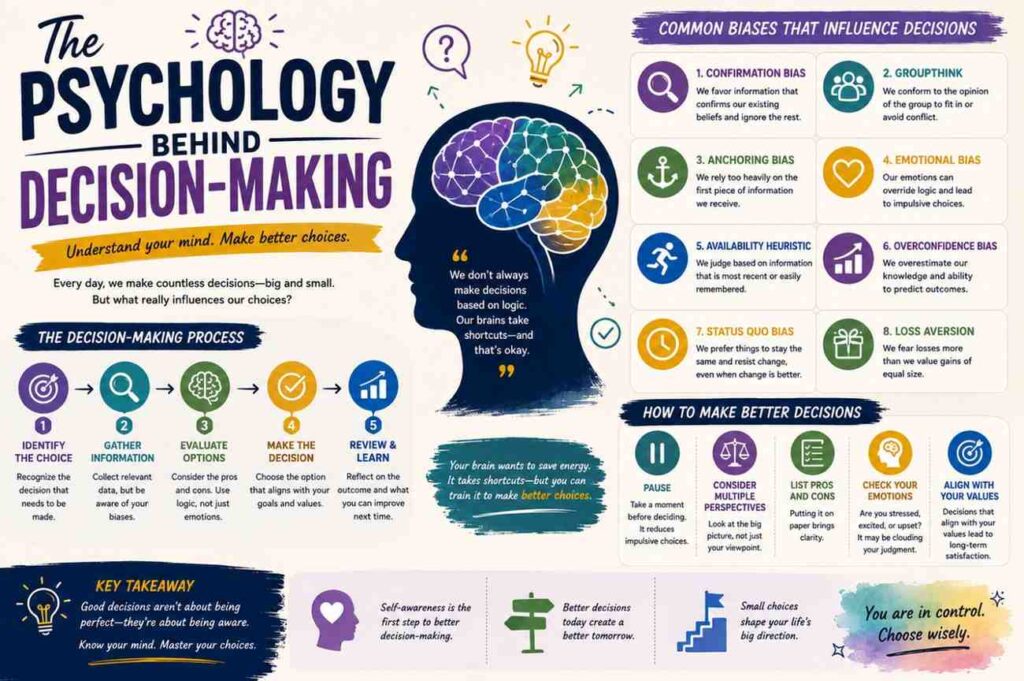
The Psychology Behind Decision Making Explained
Decision making is a fundamental part of everyday life, influencing everything from simple daily choices to major personal and professional decisions. The psychology behind decision making explores how people evaluate options, process information, and ultimately choose a course of action. Rather than being purely logical, most decisions are shaped by a combination of reasoning, emotions, past experiences, and environmental influences.
Psychologists have found that the human brain uses both conscious and unconscious processes when making decisions. While some choices involve careful analysis and deliberate thinking, many others are made quickly through mental shortcuts known as heuristics. These shortcuts help people make decisions efficiently but can sometimes lead to biases and errors in judgment.
Emotions also play a significant role in decision making. Feelings such as fear, excitement, confidence, or uncertainty can influence how risks and rewards are perceived. In many situations, emotional responses guide decisions even when individuals believe they are acting rationally. Understanding this connection helps explain why people sometimes make choices that appear illogical from an outside perspective.
Modern research in psychology and neuroscience continues to reveal how cognitive processes, social influences, and brain activity affect decision making. By understanding these mechanisms, individuals can become more aware of their own thinking patterns, reduce common biases, and make more informed decisions in both personal and professional life.
Understanding Decision Making in Human Psychology
Decision making is a core cognitive function that shapes nearly every aspect of human life. From routine choices like what to eat or wear, to high-stakes decisions involving career, relationships, or finances, the human brain is constantly evaluating options. The psychology behind decision making helps us understand not only what choices people make, but also why they make them in specific ways. These decisions are rarely purely logical; instead, they emerge from a complex interaction between cognition, emotion, experience, and environmental cues.
Modern psychology suggests that decision making is not a single unified process but rather a layered system influenced by mental shortcuts, emotional responses, and cognitive limitations. For example, people often assume they are acting rationally, yet research in behavioral science shows that unconscious biases frequently shape outcomes more than deliberate reasoning. This is why two individuals presented with the same information may arrive at completely different conclusions.
Understanding decision making psychology is essential in fields like marketing, education, business strategy, and even personal development. It allows us to identify patterns in human behavior and improve the quality of choices we make daily. By studying how the brain processes information, we gain insights into why humans sometimes act against their own best interests, even when better options are clearly available.
What Is Decision Making Psychology?
Decision making psychology is the scientific study of how individuals evaluate alternatives and choose a course of action. It combines insights from cognitive psychology, neuroscience, and behavioral economics to explain how thought processes influence decisions. At its core, this field examines how people gather information, interpret it, and convert it into action.
One key aspect of this discipline is that it recognizes human limitations. Unlike traditional economic models that assume perfect rationality, psychology acknowledges that humans often operate with incomplete information and limited cognitive resources. This means decisions are frequently based on “good enough” reasoning rather than optimal analysis.
In practical terms, decision making psychology helps explain everyday behavior. For example, why consumers prefer certain brands, why people procrastinate, or why individuals struggle with long-term planning. It also provides insight into how habits are formed and how past experiences influence future choices. Overall, this field reveals that decision making is not just a logical process but a deeply psychological one shaped by internal and external factors.
Rational vs Emotional Thinking
Human decision making is often described as a balance between rational thinking and emotional influence. Rational thinking involves logical analysis, evaluation of evidence, and structured reasoning. Emotional thinking, on the other hand, is driven by feelings, instincts, and immediate reactions. In real-world situations, these two systems rarely operate independently.
For instance, a person may logically know that investing early is beneficial, but fear of loss or uncertainty may prevent them from taking action. Similarly, excitement or optimism can lead to impulsive decisions that overlook long-term consequences. This interaction between logic and emotion is what makes human behavior unpredictable yet fascinating.
Emotions often serve as shortcuts, helping individuals make quick decisions in complex environments. However, they can also distort perception, especially under stress or pressure. Understanding this balance is essential for improving self-awareness and making more consistent decisions in both personal and professional life.
Role of the Brain in Decision Making
The human brain plays a central role in shaping decisions through a network of specialized regions. The prefrontal cortex is responsible for higher-order thinking such as planning, reasoning, and impulse control. It helps individuals evaluate consequences and make structured decisions. In contrast, the amygdala processes emotions like fear, pleasure, and threat detection.
When these regions work together effectively, decisions tend to be balanced and thoughtful. However, when emotional responses dominate, especially in stressful situations, decision quality can decline. This is why people often make rushed or irrational choices during emotional events.
Neuroscience research shows that decision making is not isolated to one brain region but is the result of complex communication between multiple neural systems. Understanding this biological foundation helps explain why humans sometimes struggle with consistency in their choices, even when they are aware of better alternatives.
Dual Process Theory and How We Think
Dual process theory is one of the most influential frameworks in understanding the psychology behind decision making. It explains how the brain uses two distinct systems to process information: one fast and intuitive, the other slow and analytical. This theory, widely popularized by Daniel Kahneman, provides deep insight into how humans think under different conditions.
This model is essential because it explains why people can make both extremely quick judgments and highly calculated decisions depending on context. It also highlights why errors occur when the wrong system dominates a situation. For example, relying on intuition in complex financial decisions can lead to mistakes, while overanalyzing simple choices can lead to inefficiency and delay.
Dual process theory is widely used in psychology, behavioral economics, and artificial intelligence research. It helps explain everything from consumer behavior to risk-taking patterns. Understanding these two systems allows individuals to become more aware of when they are thinking automatically versus deliberately, which is crucial for improving decision quality.
| Feature | System 1 Thinking | System 2 Thinking |
|---|---|---|
| Speed | Very fast | Slow and deliberate |
| Effort Required | Low effort | High mental effort |
| Type of Thinking | Intuitive and emotional | Logical and analytical |
| Accuracy Level | Moderate to low | High accuracy |
| Usage Examples | Driving, reacting, daily habits | Problem solving, planning, analysis |
| Risk Level | Higher chance of bias | Lower chance of bias |
| Energy Consumption | Low brain energy | High brain energy |
| Decision Style | Automatic response | Conscious decision making |
System 1 Thinking (Fast and Intuitive)
System 1 thinking operates automatically and quickly, requiring little conscious effort. It is responsible for instinctive reactions, emotional judgments, and habitual behaviors. This system is highly efficient and helps humans respond rapidly to everyday situations without overthinking.
For example, recognizing a familiar face, reacting to danger, or completing routine tasks are all governed by System 1. It relies heavily on patterns, memory, and learned experiences. While this makes decision making faster, it can also introduce errors when assumptions are incorrect.
System 1 is particularly influential in situations involving uncertainty or time pressure. In such cases, the brain prioritizes speed over accuracy. While this can be useful for survival, it may lead to biased judgments in complex environments like finance, health, or strategic planning.
System 2 Thinking (Slow and Logical)
System 2 thinking is deliberate, analytical, and requires conscious effort. It is activated when individuals solve complex problems, evaluate multiple options, or engage in critical thinking. Unlike System 1, it is slower but more accurate.
This system is responsible for tasks such as mathematical calculations, strategic planning, and logical reasoning. It allows individuals to override automatic responses and evaluate situations more carefully. However, because it requires mental energy, people often avoid using it unless necessary.
System 2 thinking plays a crucial role in improving decision quality. By engaging this system, individuals can reduce impulsive behavior and make more informed choices. However, it must be actively engaged, as the brain naturally prefers the efficiency of System 1.
Why We Rely on Mental Shortcuts
Mental shortcuts, or heuristics, are cognitive strategies the brain uses to simplify complex decisions. These shortcuts allow individuals to make quick judgments without analyzing every detail. While highly efficient, they can sometimes lead to systematic errors in thinking.
Heuristics are essential for daily functioning because the brain cannot process every piece of information in depth. However, they often rely on incomplete or biased information. For example, people may judge the likelihood of an event based on how easily they can recall similar examples, rather than actual probability.
Understanding these shortcuts is important because it helps individuals recognize when their thinking may be biased. By becoming aware of heuristics, people can slow down their reasoning process and make more balanced decisions.
Cognitive Biases That Shape Our Decisions
Cognitive biases are systematic patterns of deviation from rational judgment. They are a central concept in the psychology behind decision making because they explain why humans often make predictable errors. These biases influence how people interpret information, evaluate risks, and form opinions.
Cognitive biases are not random mistakes; they are built into the way the brain processes information efficiently. While they help in simplifying decision making, they can also distort reality. Researchers like Amos Tversky and Daniel Kahneman extensively studied how these biases shape human judgment.
Understanding cognitive biases is essential for improving critical thinking and avoiding common mental traps in everyday life, business, and finance.
| Psychological Factor | What It Means | Real-Life Impact | Article Section Fit |
|---|---|---|---|
| Cognitive Biases | Systematic errors in thinking that distort judgment | Leads to poor financial, emotional, and social decisions | Cognitive Biases That Shape Our Decisions |
| System 1 Thinking | Fast, automatic, intuitive brain processing | Causes quick reactions but increases mistakes | Dual Process Theory |
| System 2 Thinking | Slow, logical, effort-based thinking | Improves accuracy in complex decisions | Dual Process Theory |
| Heuristics | Mental shortcuts used to simplify decisions | Speeds up thinking but may reduce accuracy | Why We Rely on Mental Shortcuts |
| Emotional Influence | Decisions driven by feelings instead of logic | Causes impulsive or risk-based choices | Emotional and Social Influences |
| Social Proof | Following others’ behavior in uncertain situations | Affects buying, opinions, and trends | Social Proof and Peer Influence |
Common Cognitive Biases in Daily Life
Several cognitive biases influence everyday decision making. Confirmation bias leads people to favor information that supports their existing beliefs while ignoring contradictory evidence. Anchoring bias causes individuals to rely heavily on the first piece of information they receive, even if it is irrelevant. Availability bias makes people judge events based on how easily examples come to mind.
These biases affect decisions in subtle ways. For example, in purchasing behavior, consumers may overvalue products they have seen repeatedly in advertisements. In professional settings, managers may rely on first impressions when evaluating candidates.
Recognizing these biases helps individuals develop more objective thinking patterns and improve the quality of their decisions over time.
Prospect Theory and Risk Perception
Prospect theory explains how people evaluate potential gains and losses. Developed by Amos Tversky and Daniel Kahneman, it shows that losses generally feel more impactful than equivalent gains.
This means that people are more motivated to avoid losses than to achieve gains. For example, losing money feels psychologically stronger than gaining the same amount. This imbalance influences financial decisions, investment behavior, and risk-taking strategies.
Prospect theory is widely used in economics and behavioral science to explain real-world decision patterns that traditional models cannot predict.
Bounded Rationality Explained
Herbert Simon introduced the concept of bounded rationality, which suggests that humans make decisions based on limited information, cognitive capacity, and time constraints. Instead of finding the optimal solution, people settle for a satisfactory one.
This concept challenges the idea of perfect rationality in decision making. It explains why individuals often make decisions that are “good enough” rather than ideal. In real life, this is a practical approach because analyzing every possible option is often impossible.
Bounded rationality helps explain why humans rely on heuristics and why decision quality varies depending on context and available resources.
Emotional and Social Influences on Decision Making
Emotions and social environment play a powerful role in shaping decisions. Human beings are inherently social creatures, and their choices are influenced not only by logic but also by feelings, cultural norms, and peer behavior.
Emotional states such as happiness, stress, fear, or excitement can significantly alter perception and judgment. Social factors such as group behavior, societal expectations, and authority figures also affect how individuals make decisions. This makes decision making a highly dynamic process influenced by both internal and external factors.
Emotional Triggers in Decision Making
Emotions act as powerful triggers that influence how people evaluate choices. For example, fear can lead to risk avoidance, while excitement can lead to impulsive decisions. Stress often reduces cognitive capacity, making it harder to think logically.
Emotional responses are often immediate and automatic, which means they can override rational thinking. While emotions can be helpful in guiding decisions quickly, they may also lead to inconsistent or biased outcomes.
Understanding emotional triggers helps individuals regulate their responses and improve decision consistency in high-pressure situations.
Social Proof and Peer Influence
Social proof refers to the tendency of individuals to follow the actions of others, especially when uncertain. People often rely on reviews, recommendations, and group behavior to guide their decisions.
This influence is particularly strong in digital environments, where ratings and social media trends shape consumer behavior. When individuals see others making a choice, they often assume it is the correct or safe option.
While social proof can be helpful, it can also lead to herd behavior, where people make decisions without independent evaluation.
Cultural and Environmental Factors
Culture and environment shape values, beliefs, and decision-making patterns. Cultural norms influence what is considered acceptable or desirable behavior, while environmental conditions affect access to resources and opportunities.
For example, individuals raised in risk-averse cultures may prefer stable choices, while others may be more open to experimentation. Similarly, economic conditions can significantly influence financial decisions and priorities.
Understanding these influences helps explain differences in decision-making behavior across societies.
Behavioral Economics and Real-World Applications
Behavioral economics is a field that combines psychology and economics to understand how people actually make decisions in real-world situations. Traditional economic theories often assume that individuals behave rationally and always make choices that maximize their benefits. However, behavioral economics recognizes that emotions, cognitive biases, habits, and social influences frequently affect decision making in ways that are not entirely logical.
This field provides valuable insights into why people sometimes act against their own financial or personal interests. Researchers have discovered that small changes in how choices are presented can significantly influence behavior. As a result, behavioral economics is widely applied in areas such as marketing, public policy, healthcare, and financial planning to encourage better decision outcomes.
How Businesses Use Decision Psychology
Businesses actively use decision psychology to influence customer behavior and improve sales. By understanding how people evaluate options and respond to different stimuli, companies can design marketing campaigns, pricing structures, and shopping experiences that encourage specific actions. These strategies are based on psychological principles that shape consumer perceptions and preferences.
For example, limited-time offers create a sense of urgency that motivates faster purchasing decisions, while strategic product placement can increase perceived value and visibility. User experience design also relies heavily on decision psychology to make websites and applications easier to navigate, ultimately guiding customers toward desired actions such as making a purchase or signing up for a service.
Nudging and Decision Design
Nudging is a concept in behavioral economics that involves subtly guiding people toward certain decisions without removing their freedom of choice. Rather than forcing behavior, nudges influence how options are presented, making beneficial choices easier or more appealing. This approach helps individuals make better decisions while maintaining full control over their actions.
Common examples include setting beneficial options as defaults, organizing healthier foods at eye level in cafeterias, or simplifying important forms and processes. Nudging has become widely used in public policy, healthcare systems, financial planning, and digital platforms because it can improve outcomes without relying on strict rules or penalties.
Financial Decision Making Errors
Financial decision making is often affected by emotions, cognitive biases, and incomplete information. Many people make mistakes such as impulsive spending, excessive risk-taking, poor investment timing, or ignoring long-term financial consequences. These errors can have a significant impact on personal wealth and financial stability over time.
Understanding the psychological factors behind financial decisions helps individuals make more informed choices. By recognizing common biases such as overconfidence, loss aversion, and emotional spending, people can develop better financial habits, improve self-control, and create strategies that support long-term financial success.
Improving Your Decision Making Skills
Improving decision-making skills is a continuous process that involves self-awareness, critical thinking, and deliberate practice. While every individual makes decisions daily, the quality of those decisions often depends on how effectively information is evaluated and how well emotional influences are managed. By understanding the psychological factors that shape choices, people can develop strategies that lead to more balanced and effective outcomes.
Better decision making is not about eliminating emotions or always making perfect choices. Instead, it involves creating a structured approach that reduces unnecessary mistakes and improves judgment over time. With consistent practice, individuals can strengthen their ability to analyze situations, evaluate risks, and make decisions that align with their long-term goals and values.
Slow Down Thinking Process
One of the most effective ways to improve decision making is to slow down the thinking process when facing important choices. Many mistakes occur because decisions are made too quickly under pressure, emotion, or incomplete information. Taking additional time allows the brain to move beyond automatic reactions and engage in deeper analysis.
This slower approach activates more deliberate and rational thinking, helping individuals carefully evaluate available options and potential consequences. As a result, decisions tend to be more accurate, thoughtful, and less likely to lead to regret or unintended outcomes.
Recognize Cognitive Biases
Cognitive biases are mental shortcuts that can distort judgment and influence decisions without conscious awareness. These biases often cause individuals to rely on assumptions, overlook important information, or interpret situations in a way that confirms existing beliefs. Recognizing these patterns is a critical step toward improving decision quality.
When people become aware of common biases such as confirmation bias, overconfidence, and availability bias, they are more likely to question their assumptions and seek objective evidence. This increased awareness helps create more balanced thinking and leads to better decisions in both personal and professional settings.
Use Structured Decision Models
Structured decision-making models provide a systematic way to evaluate choices and reduce the influence of emotions. Tools such as decision matrices, pros-and-cons lists, and cost-benefit analyses help organize information clearly, making complex decisions easier to understand and compare.
These frameworks encourage logical thinking by breaking decisions into manageable components and assessing each option based on defined criteria. Over time, using structured methods improves consistency, increases confidence, and helps individuals make more informed decisions that support their long-term objectives.
Real-Life Examples of Decision Making Psychology
Decision-making psychology can be observed in nearly every aspect of daily life, from the products people buy to the careers they pursue and the health choices they make. While individuals often believe their decisions are based purely on logic, research shows that emotions, biases, social influences, and environmental factors frequently play a significant role. Understanding these real-world examples helps illustrate how psychological principles influence behavior in practical situations.
By examining everyday decisions through a psychological lens, it becomes easier to recognize common patterns and improve future choices. Awareness of these influences allows individuals to make more deliberate decisions rather than relying solely on automatic reactions or external pressures.
Shopping Behavior and Marketing Influence
Consumer purchasing decisions are heavily influenced by psychological factors such as branding, pricing, advertising, and product presentation. Businesses carefully design marketing strategies to appeal to emotions and create positive associations with their products. As a result, purchasing decisions are often driven by perception as much as by actual product value.
Psychological triggers such as scarcity, social proof, and limited-time offers can significantly increase the likelihood of a purchase. When consumers see that a product is popular or available for a limited period, they may feel a stronger urge to buy, even if they had not originally planned to do so.
Career and Life Decisions
Career and major life decisions are often shaped by a combination of logic, emotions, and social influences. While factors such as salary, job opportunities, and personal interests are important, many people are also influenced by family expectations, cultural norms, and perceptions of security and success.
Emotional considerations frequently play a larger role than individuals realize. Fear of failure, desire for approval, or concerns about stability can affect decision-making processes and sometimes lead people to choose paths that differ from their true preferences or long-term goals.
Health-Related Choices
Health-related decisions provide another clear example of how psychology influences behavior. Even when individuals understand the long-term benefits of healthy habits such as exercise, balanced nutrition, and preventive care, they may still prioritize short-term comfort or convenience.
Psychological factors such as immediate gratification, habit formation, and emotional responses often affect health behaviors. Understanding these influences can help individuals create better strategies for maintaining healthy lifestyles and making decisions that support long-term wellbeing rather than short-term satisfaction.
Quick Summary of Decision Making Psychology Concepts
Decision making is a complex psychological process influenced by a mix of rational thinking, emotional responses, and cognitive shortcuts. While people often believe they make fully logical choices, research in psychology shows that emotions, past experiences, and mental biases play a significant role in shaping everyday decisions. This combination explains why human behavior is often predictable yet not always perfectly rational.
Key theories such as dual-process theory, heuristics, and behavioral economics help explain how people evaluate options and choose between alternatives. Dual-process theory describes the interaction between fast, intuitive thinking and slow, analytical reasoning, while heuristics refer to mental shortcuts that simplify decision making but can sometimes lead to errors. Behavioral economics further expands this understanding by studying how real-world conditions influence choices beyond pure logic.
By learning these concepts, individuals can become more aware of their own thinking patterns and decision-making habits. This awareness allows people to identify biases, reduce impulsive choices, and make more intentional decisions in daily life. Over time, applying these insights can lead to better judgment, improved problem-solving, and more consistent outcomes.
Frequently Asked Questions
A Frequently Asked Questions (FAQ) section is a structured part of an article, blog, or website that provides clear answers to the most commonly asked questions about a specific topic. It is designed to make information easier to understand by presenting key points in a simple question-and-answer format.
FAQs help readers quickly find important information without having to read the entire content. This improves clarity, saves time, and enhances the overall user experience.
Why do humans make irrational decisions?
Humans often make irrational decisions because the brain does not always rely on slow, logical analysis. Instead, it frequently uses emotional responses and mental shortcuts to save time and energy. While these shortcuts are useful in everyday life, they can sometimes lead to errors in judgment, especially in stressful or uncertain situations where clear thinking is harder to maintain.
In many cases, irrational decisions are influenced by habits, emotions, or past experiences rather than objective evaluation. This means people may act in ways that do not fully align with their long-term goals, even when they believe they are being logical.
What are cognitive biases in decision making?
Cognitive biases are systematic patterns of thinking that distort how people perceive information and make decisions. These biases occur because the brain simplifies complex information processing, which can lead to inaccurate interpretations of reality. As a result, individuals may misjudge risks, overestimate probabilities, or ignore important details.
Common biases affect areas such as memory, decision-making under pressure, and evaluation of outcomes. Understanding these biases is important because it helps individuals recognize when their thinking may be influenced by subconscious patterns rather than objective facts.
What is System 1 and System 2 thinking?
System 1 thinking is fast, automatic, and intuitive. It allows people to make quick decisions without much effort, often based on instincts or past experiences. This type of thinking is useful in everyday situations where immediate responses are needed.
System 2 thinking, on the other hand, is slow, deliberate, and analytical. It requires focused effort and is used for complex problem-solving or important decisions. Together, these two systems work to balance efficiency and accuracy in human decision making, depending on the situation.
How can I improve my decision-making skills?
Decision-making skills can be improved by becoming more aware of how the mind processes information and by deliberately slowing down when making important choices. Taking time to analyze options reduces impulsive reactions and leads to more thoughtful outcomes.
Other effective strategies include recognizing cognitive biases, using structured tools like decision matrices, and considering different perspectives before finalizing a choice. Over time, these habits strengthen judgment and lead to more consistent and reliable decisions.
What is prospect theory in psychology?
Prospect theory explains how people evaluate potential gains and losses in decision making. It suggests that losses tend to feel more emotionally intense than gains of the same size, which often leads people to avoid risks even when the potential reward is significant.
This theory helps explain many real-life financial and personal decisions, where fear of loss can outweigh the possibility of gain. It highlights how emotional perception, rather than pure logic, strongly influences human choices.
Can emotions improve decision making?
Yes, emotions can improve decision making by providing important signals about what feels right or wrong in a given situation. In uncertain or complex environments, emotional responses can help guide attention and highlight important factors that might otherwise be overlooked.
However, emotions can also lead to biased or impulsive decisions if they are too strong or not balanced with rational thinking. The most effective decisions usually come from a combination of emotional awareness and logical analysis working together.
Conclusion
The psychology behind decision making reveals that human choices are shaped by a complex interaction of logic, emotion, cognitive biases, and environmental influences. While people often assume they make decisions purely based on rational thinking, research shows that subconscious factors and mental shortcuts frequently guide behavior in subtle ways. Understanding these influences provides a clearer picture of why people think and act the way they do in everyday situations.
By becoming aware of these psychological processes, individuals can significantly improve the quality of their decisions. This awareness helps reduce the impact of biases, encourages more balanced thinking, and supports better judgment in both personal and professional life. Over time, learning to recognize these hidden influences allows people to develop stronger thinking habits and make more intentional, informed choices.