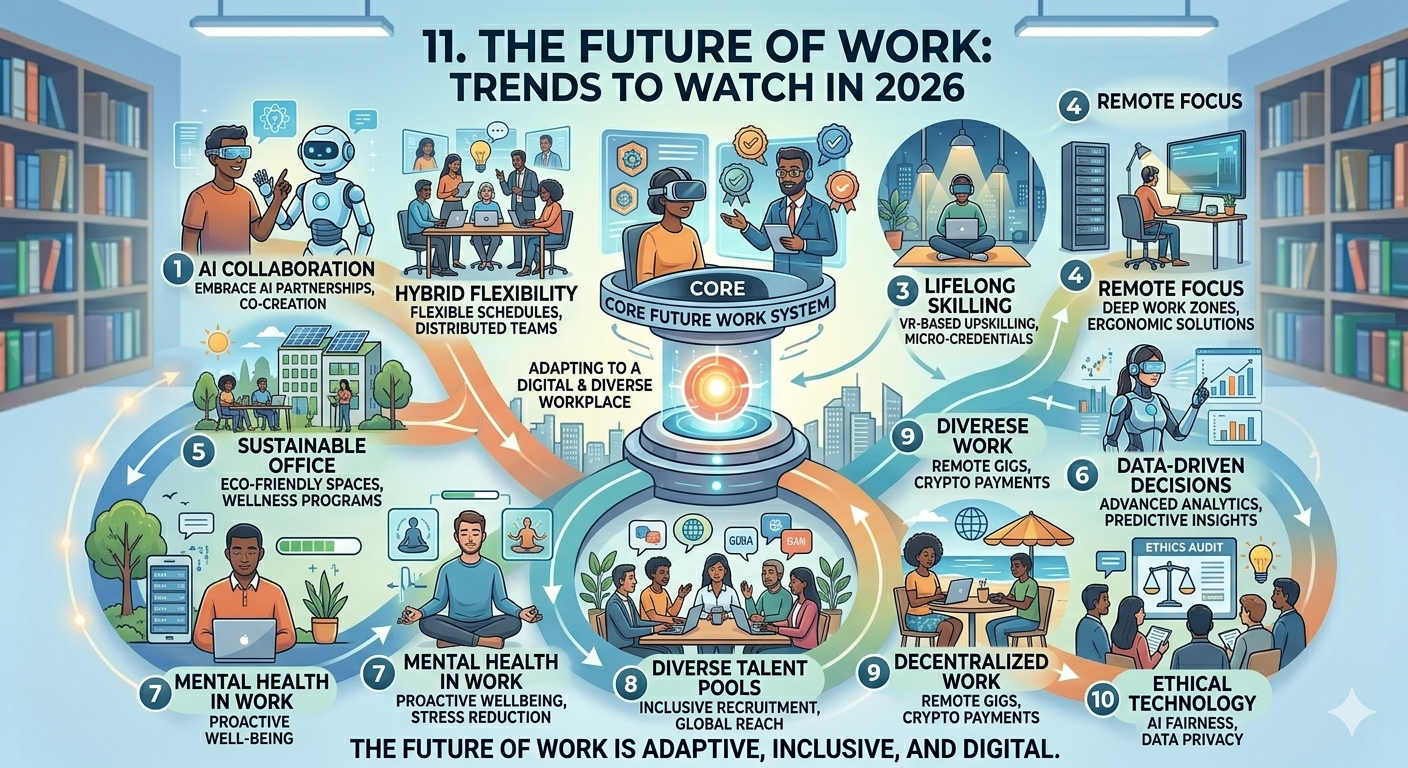
The Future of Work: Trends to Watch in 2026

The Future of Work: Trends to Watch in 2026

The Future of Work: Trends to Watch in 2026

The discussion around the future of work 2026 has moved beyond abstract predictions. Businesses are now deciding which tasks artificial intelligence should perform, which decisions require human oversight, how managers should evaluate AI-supported performance and what employees need to learn as job responsibilities change. Generative AI has become part of real workplace systems, making organizational design increasingly important alongside technological capability.

Research from organizations including the World Economic Forum, Microsoft, OECD, International Labour Organization and Gallup shows that several forces are interacting simultaneously. AI adoption is accelerating, skill requirements are evolving, early-career roles are being reconsidered, hybrid work remains established and employee engagement continues to challenge organizations. These developments are not isolated. Changes in one area often create pressure in another.

The World Economic Forum’s Future of Jobs research found that employers expect a substantial share of workers’ existing skills to change by 2030. The International Labour Organization, meanwhile, has emphasized that generative AI exposure does not automatically mean complete job replacement. For many occupations, transformation is more likely because only part of the job can be automated effectively.

Understanding The Future of Work: Trends to Watch in 2026 therefore requires looking at jobs as collections of tasks, relationships and responsibilities rather than fixed labels. The most important question is not whether humans or machines will “win.” It is how organizations can combine technology, talent and management systems to produce better outcomes while preserving pathways for people to learn, contribute and advance.

2026 TrendWhat Is ChangingWhat Employers Should DoWhat Workers Should Do
AI agentsMore execution can be delegated to AIRedesign workflows and accountabilityLearn delegation and verification
Human judgmentAI increases the importance of quality controlKeep humans responsible for outcomesStrengthen critical thinking
Skills accelerationJob requirements are changing quicklyBuild continuous learning systemsDevelop AI, digital and human skills
Entry-level redesignRoutine junior tasks face automationProtect learning pathwaysBuild applied experience
Hybrid workFlexibility remains durableSet team-level operating normsMaster distributed collaboration
Engagement pressureManagers and teams face strainImprove management qualitySeek clarity, growth and meaningful work

AI Agents Will Change How Work Is Organized

Artificial intelligence in 2026 is increasingly moving from a personal productivity tool into the structure of organizational workflows. Earlier adoption often focused on using generative AI to draft an email, summarize a document or answer a question. The emerging model is more ambitious. AI agents can support multi-step work by gathering information, analyzing material, preparing outputs and helping employees coordinate sequences of tasks that previously required more manual effort.

AI Agent Workplace AreaTypical AI ContributionHuman ResponsibilityBusiness Impact
Research & Information GatheringCollecting, summarizing and organizing informationChecking accuracy, relevance and contextFaster research cycles
Data AnalysisIdentifying patterns and preparing preliminary insightsInterpreting findings and making decisionsMore efficient analytical work
Content & Document CreationProducing drafts, summaries and routine documentationEditing, fact-checking and applying expertiseReduced repetitive workload
Workflow ExecutionHandling defined multi-step digital tasksSetting goals, permissions and escalation rulesGreater process automation
Monitoring & ReportingTracking activity and generating routine reportsReviewing exceptions and business risksFaster operational visibility
Customer SupportHandling common requests and routing casesManaging complex, sensitive or high-value interactionsImproved response efficiency
Quality ControlDetecting inconsistencies and potential errorsFinal validation and accountabilityStronger review processes
Decision SupportComparing options and surfacing relevant informationApplying judgment and approving outcomesBetter-informed decision-making

Microsoft’s 2026 Work Trend Index reflects this transition toward more agent-supported work. Its research suggests that users are increasingly delegating cognitive tasks while remaining responsible for direction and review. That distinction matters. An agent may accelerate execution, but the organization still needs someone to define the objective, decide whether the reasoning is appropriate, verify the result and accept accountability for the final business decision.

The practical consequence is that leaders must redesign workflows instead of simply placing AI tools on top of existing processes. A poorly designed approval chain remains inefficient even when every participant has access to an advanced assistant. Businesses should identify where delays occur, where information is repeatedly copied, where employees perform low-value administrative work and where judgment is essential. The best use of AI in the workplace will often come from combining automation with clearer processes, better information access and explicit human ownership rather than pursuing automation as an objective by itself.

Human Judgment Becomes More Valuable as AI Improves

As AI systems become better at producing polished answers, the ability to evaluate those answers becomes more valuable. Microsoft’s workplace research has highlighted that many employees see AI-generated output as a starting point rather than a finished product. That attitude is important because fluent language, professional formatting or rapid analysis does not guarantee that an output is accurate, complete or appropriate for a particular decision.

Human judgment is especially important when work contains ambiguity. A manager choosing between two strategic options, a healthcare professional interpreting patient information or a financial team reviewing a risk cannot rely exclusively on a generated answer. People must understand the broader context, identify missing assumptions and determine whether the recommendation fits legal, ethical, customer or operational requirements.

This creates a more sophisticated model of AI literacy. Employees need more than the ability to generate content quickly. They need to recognize when independent verification is necessary, when AI should not receive sensitive information and when a task should remain primarily human. Workers who combine technical fluency with sound judgment are better positioned to use automation safely without surrendering responsibility for the quality of their work.

Organizations Will Need to Redesign Roles Around Tasks

Traditional job descriptions combine many different responsibilities under a single title. A marketing manager may analyze data, write briefs, attend meetings, coordinate agencies and approve campaigns. A financial analyst may gather data, build models, prepare presentations and explain findings. AI makes it easier to separate these activities and ask which specific tasks can be automated or augmented rather than asking whether the entire occupation can disappear.

A useful redesign process starts with workflow mapping. Leaders can break a role into research, data entry, drafting, communication, review, decision-making and relationship-based work. Each component can then be assessed according to complexity, risk and the value of human involvement. Routine information processing may be appropriate for automation, while negotiation or final approval may continue to require direct human responsibility.

The International Labour Organization’s analysis of generative AI supports this task-level view by emphasizing transformation over universal job replacement. That distinction should shape workforce planning. Instead of estimating how many positions technology could theoretically remove, employers should determine how occupations will change and which new responsibilities employees can assume when routine work consumes less time. Effective redesign should expand meaningful contribution rather than simply reduce headcount.

Related Articles 

Skills, Hiring and Career Paths Will Change Faster

Skills are becoming a more important unit of workforce planning because job titles alone reveal less about what an employee can actually do. The World Economic Forum’s Future of Jobs research indicates that employers expect a significant portion of current worker skills to change or become outdated through 2030. AI, data, cybersecurity and technology literacy are rising alongside creative thinking, resilience, adaptability and lifelong learning.

These changes are also reflected in broader career trends in 2026, where adaptability, digital capability and continuous learning are becoming increasingly important to long-term career development.

This means the familiar distinction between “technical” and “soft” skills is becoming less useful. Most modern roles require a combination of both. An employee may need to understand AI-supported tools, interpret data and navigate digital systems while also explaining complex information clearly, solving unfamiliar problems and working effectively with customers or colleagues. Organizations that focus exclusively on technical training can overlook the judgment and communication skills needed to turn technology into useful business results.

Hiring practices are likely to adjust accordingly. Degrees and previous job titles will remain relevant in many professions, especially regulated fields, but employers increasingly benefit from understanding what candidates can demonstrate today. Skills-first hiring can include work samples, portfolios, practical assessments and evidence of applied learning. The larger trend is toward more continuous capability development after hiring. Employees cannot assume that qualifications earned early in their careers will cover every future requirement, while employers cannot expect to solve every emerging skill gap through external recruitment.

Skill CategoryKey CapabilitiesWorkplace ApplicationLong-Term Value
AI LiteracyAI tool use, task delegation and output evaluationWorking effectively with AI-supported workflowsAdaptability to evolving technology
Digital SkillsDigital tools, platforms and workflow systemsManaging technology-enabled processesStronger workplace flexibility
Data SkillsData interpretation, analysis and validationSupporting evidence-based decisionsBetter analytical capability
Critical ThinkingEvaluation, reasoning and error detectionReviewing AI outputs and complex informationHigher-quality judgment
Problem-SolvingDiagnosis, experimentation and solution designHandling unfamiliar workplace challengesGreater resilience
CreativityIdea generation, innovation and original thinkingDeveloping products, strategies and solutionsHuman differentiation
CommunicationWriting, collaboration and stakeholder interactionCoordinating people and technologyStronger teamwork
Domain ExpertiseIndustry knowledge and practical experienceApplying AI within specialized workflowsGreater professional authority
Management SkillsCoaching, decision-making and team coordinationLeading human-AI teams and organizational changeStronger organizational performance
Lifelong LearningContinuous training and skill developmentAdapting to changing tools and job requirementsSustainable career growth

AI Literacy Will Matter More Than Advanced AI Engineering

Preparing employees for AI does not mean turning every worker into a machine-learning engineer. OECD research distinguishes between the relatively small group that needs advanced technical skills to develop AI systems and the much larger workforce that needs enough understanding to use AI effectively within existing occupations. That difference should shape both education and corporate training.

For most employees, AI literacy means understanding how to frame a task, supply appropriate context, evaluate output and recognize limitations. It also includes knowing when confidential information should not be entered into a system, how organizational policies apply and when expert review is necessary. These skills are relevant across marketing, finance, operations, HR, sales and many professional services.

Training should therefore be designed around actual work. A salesperson needs different AI skills from an accountant, software developer or healthcare administrator. General awareness sessions may help people understand the technology, but lasting capability comes from practicing with relevant tasks. Employers that combine role-specific training with clear governance can increase adoption while reducing the risk of employees using AI in inconsistent or inappropriate ways.

Entry-Level Work Will Need to Be Reinvented

Entry-level positions face a distinctive challenge because many junior employees traditionally learn through repetitive tasks. Research, basic analysis, first drafts, data preparation and routine administrative work may not be the highest-value activities in an organization, but performing them has historically helped inexperienced workers understand the business and develop the knowledge needed for more complex responsibilities.

AI can automate or accelerate many of those activities, creating a potential development gap. If companies remove large amounts of junior work without creating alternative learning experiences, they may save time in the short term but weaken their future pipeline of experienced professionals. The World Economic Forum has specifically highlighted the need to rethink early-career pathways as AI changes the structure of entry-level work.

A better approach is to redesign junior roles around faster development. Entry-level employees can use AI for routine preparation while spending more time on supervised analysis, customer interaction, quality assurance, project ownership and mentoring. Managers should explain why decisions are made rather than only assigning tasks. The objective should be to remove unnecessary repetition without removing the experiences through which employees learn professional judgment.

Continuous Upskilling Becomes Part of Normal Work

Upskilling has traditionally been treated as an event: an annual course, certification program or occasional workshop. That model becomes less effective when workplace tools and processes change continuously. Employees need smaller, more frequent opportunities to learn new systems, practice updated workflows and understand how their responsibilities are changing as technology becomes embedded in everyday operations.

The OECD has reported that workers who receive employer-supported AI training are more likely to describe positive workplace outcomes. The broader lesson is that organizations should not expect employees to figure out technological change entirely on their own. Training works best when it is connected to real business problems and supported by managers who understand how new skills affect performance.

For individuals, building a diversified skills portfolio provides resilience. Domain expertise remains valuable because AI tools still require context. Adding digital literacy, communication, critical thinking, data interpretation and the ability to learn quickly makes that expertise more adaptable. Rather than tying professional identity to one software tool, employees should focus on capabilities that remain useful even when platforms and workflows change.

Hybrid Work, Management and Employee Experience Remain Critical

AI may dominate discussion about the workplace trends 2026, but where and how people work remains equally important. Hybrid work has proven durable across many remote-capable occupations, particularly where employees perform a mix of independent knowledge work and collaborative activity. Gallup’s research has shown that hybrid arrangements remain common even as some organizations tighten attendance requirements or encourage more office presence.

The challenge has shifted from deciding whether hybrid work should exist to designing it intentionally. A team may have flexibility on paper while still struggling with inconsistent schedules, poorly documented decisions, excessive meetings and employees missing information because they were not physically present. Good hybrid systems therefore require operating norms: teams need to know when synchronous collaboration matters, which activities benefit from an office and how information will remain accessible afterward.

Broader workplace trends in 2026 also point to a continued focus on flexibility, employee experience and how organizations adapt their working models as expectations evolve.

Management and employee experience sit at the center of this model. Gallup’s broader engagement research continues to show that employee engagement and manager engagement deserve attention. Technology cannot compensate for unclear priorities, weak feedback, excessive workloads or employees who do not understand how their work contributes to larger goals. As hybrid work trends mature, organizations should spend less time arguing over simple office-versus-home preferences and more time improving management quality, communication, career development and purposeful collaboration. Flexibility works best when employees know what is expected and managers have the capability to coordinate distributed teams effectively.

Hybrid Work Is Becoming an Operating Model, Not a Perk

Hybrid work is increasingly a way of organizing work rather than a special employee benefit. In a mature hybrid model, leaders decide intentionally which activities should happen face to face, which can happen asynchronously and which require real-time remote collaboration. The office becomes one tool within the operating system rather than the default location for every task.

Gallup’s research has shown that hybrid work remains common among remote-capable employees in the United States. That durability suggests employers need stable operating practices instead of repeatedly treating flexibility as a temporary experiment. Teams benefit from predictable norms around office days, meeting expectations, documentation and response times because predictability reduces the coordination burden created by distributed work.

The quality of office time also matters. Requiring employees to commute simply to perform individual computer work can create frustration without improving collaboration. In-person time becomes more valuable when it supports mentoring, relationship building, creative workshops, difficult conversations or complex planning. Organizations that can explain the purpose of presence are more likely to create an office experience that feels useful rather than symbolic.

Management Quality Becomes a Strategic Advantage

Managers sit at the intersection of almost every major future-of-work trend. They are expected to help employees adopt AI, manage hybrid teams, maintain performance, support development and communicate organizational change. At the same time, many managers continue to carry substantial individual workloads, leaving less time for the coaching and coordination their teams actually need.

Gallup’s workplace research has highlighted declines in manager engagement, making this a strategic issue rather than a narrow HR concern. A disengaged or overloaded manager can become a bottleneck even when employees have access to excellent technology. Team members may receive inconsistent feedback, unclear priorities or insufficient support because the person responsible for coordinating the work lacks time or energy.

Businesses should therefore redesign management alongside workflows. Managers need training in AI-supported work, coaching, distributed-team leadership and decision-making. Organizations should also review spans of control and administrative burdens. If AI can reduce reporting or scheduling work, the saved time should allow managers to focus more on people. Better management can translate technology investment into stronger execution and healthier employee experiences.

Engagement and Meaning Will Matter Alongside Productivity

Productivity is a central reason companies invest in AI and workflow automation, but it is not the only measure of a healthy workplace. Gallup’s State of the Global Workplace research continues to emphasize the economic consequences of low employee engagement. Workers who lack clarity, development, recognition or connection may have modern tools without feeling motivated to contribute fully.

This issue could become more important as automation removes routine work. Some repetitive tasks are frustrating and worth eliminating, but they can also give employees visible evidence that something has been completed. When AI performs more execution, organizations need to clarify the higher-value responsibilities that remain. Employees should understand where judgment, relationships and creativity create meaningful contribution.

The strongest organizations will therefore combine efficiency with job quality. Employees need appropriate autonomy, realistic workloads and opportunities to develop. They also need to see how their work affects customers, colleagues or organizational goals. AI can create capacity, but leaders still decide whether that capacity becomes better work, heavier workloads or fewer development opportunities. Those choices will shape engagement as much as the technology itself.

Quick Answer About The Future of Work: Trends to Watch in 2026

The Future of Work: Trends to Watch in 2026 is being shaped by a shift from experimenting with artificial intelligence to redesigning real workflows around it. AI agents are increasingly capable of researching, drafting, summarizing and supporting execution, but organizations still need people to set direction, review outputs, make judgment calls and remain accountable for results. Current workplace research therefore points toward human-AI collaboration rather than a simple scenario in which technology removes the need for people.

A second major shift involves skills. Employers are placing greater emphasis on AI literacy, digital capability, critical thinking, communication, problem-solving and continuous learning because the content of many jobs is changing faster than traditional job titles. At the same time, businesses are reconsidering how junior employees gain experience when some of the repetitive tasks historically assigned to entry-level workers can now be automated. The challenge is to preserve development opportunities while improving productivity.

Hybrid work and employee experience remain equally important. Flexible work has become a durable operating model for many remote-capable roles, while management quality, engagement and organizational clarity remain major performance issues. Taken together, the evidence suggests that the future workplace will not be defined by technology alone. It will be defined by how effectively companies redesign jobs, train employees, support managers and determine which responsibilities should remain distinctly human.

What Will Define the Future Workplace?

The future workplace will increasingly be defined by how well people and AI systems divide work rather than by whether AI is present at all. Microsoft’s 2026 Work Trend Index describes a move toward AI agents taking on parts of research, analysis and execution while employees remain responsible for setting objectives, evaluating results and deciding whether the output is trustworthy enough to use.

This model changes the definition of productivity. Giving every employee an AI tool does not automatically improve performance if the surrounding organization still has unclear processes, weak management or poor decision-making. Microsoft’s research emphasizes that organizational factors such as culture, manager support and talent practices can significantly influence how much value companies receive from AI. Effective adoption therefore requires workflow redesign rather than simply another software rollout.

For workers, the implication is straightforward: technical familiarity is useful, but judgment becomes even more important. Employees need to understand what should be delegated, what requires verification and what should remain human-led. People who can combine domain expertise with AI fluency, communication and responsible decision-making are likely to create more value than those who rely on automation without understanding the context surrounding the work.

What Should Businesses Prioritize in 2026?

Businesses should begin with the work itself. Before buying additional AI tools, leaders should identify repetitive tasks, knowledge bottlenecks, approval processes and areas where employees spend time moving information between systems. Each workflow can then be reviewed to determine where AI should assist, where people should remain responsible and where a combination of both can improve quality or speed.

Training should be the second priority. The OECD’s research on AI and skills suggests that only a relatively small share of workers need advanced AI-development expertise, while a much larger group needs practical digital literacy, data interpretation, critical evaluation and role-specific AI knowledge. That means effective workplace education should be accessible to employees outside engineering and data-science teams.

The third priority is workforce development. Businesses should avoid automating junior tasks without considering how inexperienced employees will learn the judgment required for senior roles later. Organizations need redesigned apprenticeships, supervised AI-assisted work, mentoring and opportunities for early-career employees to take meaningful responsibility. The companies that handle this transition well will not merely automate work; they will improve the path through which people become more capable.

Frequently Asked Questions About The Future of Work: Trends to Watch in 2026

The Future of Work: Trends to Watch in 2026 generates practical questions because employees and employers are experiencing change at different speeds. Some organizations already use AI agents in daily workflows, while others are still establishing basic policies for generative AI. Hybrid work is standard in some industries but impossible in many frontline occupations. The future workplace is therefore developing unevenly rather than through one universal model.

The questions below focus on the areas where readers most often need clear guidance: AI-driven job change, skill development, hybrid work, entry-level employment and business preparation. Each answer distinguishes between what current research suggests and broader predictions that remain uncertain. That distinction is particularly important because confident claims about widespread job elimination or universal return-to-office mandates can oversimplify a much more complicated labor market.

For employees, the practical message is that preparation should focus on adaptability rather than trying to predict one perfect career. For employers, the priority is building systems that can change as technology and workforce expectations evolve. Both groups benefit from treating the future of work as a continuing process rather than a single transition. AI, management, skills and organizational design influence one another, so improvements in one area often depend on changes elsewhere.

What are the biggest workplace trends in 2026?

The biggest trends include AI agents moving deeper into everyday workflows, rising demand for practical AI literacy, continued importance of critical thinking and human judgment, redesign of entry-level jobs, persistent hybrid work and greater pressure on managers. Continuous upskilling is also becoming an ongoing workplace requirement rather than an occasional professional-development activity.

These trends are connected. When AI handles more routine execution, employees need stronger skills in evaluation, communication and decision-making. When entry-level tasks change, companies need alternative ways to train junior employees. When hybrid work becomes permanent, managers need systems that maintain clarity and collaboration across locations rather than relying on physical presence.

The common theme is organizational redesign. Technology alone does not determine whether a business benefits from change. Companies must decide how roles, development pathways, performance systems and management practices should evolve alongside new tools. The organizations that make these changes deliberately are more likely to achieve useful productivity gains without creating avoidable workforce problems.

Will AI replace jobs in 2026?

AI will replace some tasks and may reduce demand for certain roles, especially where work is highly standardized and digital. However, current labor research does not support the idea that most occupations will disappear immediately. The International Labour Organization has emphasized that generative AI exposure often means job transformation because occupations contain mixtures of tasks with different levels of automation potential.

A job may therefore survive while changing substantially. An analyst might spend less time collecting data and more time interpreting it. A marketer may draft content faster while devoting more attention to strategy and quality control. Administrative positions may incorporate more workflow oversight as software handles routine processing.

The impact will vary by industry, occupation and country. Workers should focus less on whether AI can technically perform one part of their job and more on which responsibilities are becoming more valuable. Domain knowledge, judgment, relationship management and accountability remain important because organizations still need people who understand what good outcomes look like.

What skills will workers need most?

Future skills will combine digital capability with distinctly human strengths. Employees increasingly need enough AI literacy to use tools appropriately, understand their limitations and verify outputs. Data interpretation, basic technological fluency and comfort with changing digital workflows will become useful across a growing range of professional roles.

At the same time, critical thinking, communication, creativity, problem-solving and adaptability remain important. These abilities help employees evaluate AI-generated information, explain decisions and handle situations where there is no clear automated answer. Domain expertise also remains valuable because an employee must understand the subject before they can reliably judge whether technology has produced something useful.

The strongest approach is therefore balanced. Workers should not abandon professional expertise to chase every new tool, but neither should they ignore technological change. Building a combination of domain knowledge, digital literacy and transferable human skills creates a more resilient foundation for careers when individual platforms and workflows continue to evolve.

Is hybrid work disappearing?

Hybrid work is not disappearing across remote-capable occupations, although specific employers continue to change their attendance policies. Gallup’s research has shown that hybrid arrangements remain common among U.S. workers whose roles can be performed remotely. That persistence suggests flexibility has become a durable part of the workplace rather than a temporary response to earlier disruptions.

What is changing is the way organizations manage hybrid work. Employers increasingly want greater coordination, predictable team schedules and clearer reasons for office attendance. Employees may still have flexibility, but companies are experimenting with arrangements that balance individual preferences with collaboration and business requirements.

The more useful question is therefore not whether hybrid work will vanish, but whether organizations can make it productive. Clear meeting norms, effective documentation, appropriate office use and strong management matter more than the label attached to the policy. Hybrid work succeeds when teams understand how to collaborate across locations without creating unequal access to information or opportunity.

How is AI affecting entry-level jobs?

AI affects entry-level jobs because many junior employees traditionally begin with routine, structured work that is easier to automate. Research, scheduling, basic drafting, data preparation and first-pass analysis are common examples. When software completes these tasks more quickly, organizations may require fewer people to perform them manually.

The concern is that those tasks also serve as learning opportunities. A junior employee who prepares analysis repeatedly develops knowledge that later supports independent judgment. If companies eliminate the work without creating another development path, they risk weakening the pipeline through which inexperienced workers become senior professionals.

Employers should therefore redesign rather than simply remove entry-level work. Junior employees can spend more time reviewing AI outputs, participating in supervised client work, solving problems and receiving structured mentoring. Used well, automation can accelerate learning. Used narrowly as a cost-cutting tool, it can reduce the experiences that employees need to build long-term expertise.

Should employees learn coding to prepare for AI?

Coding can be valuable, particularly in technology, data and automation-focused careers, but it is not a universal requirement for preparing for AI. OECD research indicates that advanced AI-development skills are necessary for only a relatively small share of workers. Most employees will interact with AI through business applications and specialized workplace tools rather than building machine-learning models themselves.

For many professionals, higher priorities include understanding how to frame a task, evaluate an output, interpret data and protect confidential information. Employees also need to recognize when an AI result should be independently checked or escalated to someone with deeper expertise.

Learning some basic technical concepts can still improve digital confidence, especially for workers who want to automate processes or communicate effectively with technical teams. However, career preparation should match the actual occupation. A finance professional may gain more value from data literacy and AI-assisted analysis than from advanced programming, while a software engineer will naturally need deeper technical expertise.

How can businesses prepare for the future of work?

Businesses should begin by mapping important workflows rather than starting with technology procurement. Identify where employees spend time on repetitive processing, information retrieval, manual coordination or basic drafting. Then determine which tasks AI can support safely, where humans should retain direct responsibility and what controls are needed before outputs influence important decisions.

The second step is workforce development. Provide role-specific AI training, strengthen digital literacy and redesign entry-level experiences so employees can continue building judgment. Managers need additional support because they are responsible for implementing new workflows while maintaining performance, engagement and career development.

Finally, businesses should measure outcomes rather than simply adoption. More AI usage does not automatically mean greater productivity or better work. Track time saved, quality, errors, customer outcomes, employee experience and whether the organization is building stronger capabilities. The goal is not to prove that AI is being used everywhere; it is to create a better operating model

Conclusion

The workplace of 2026 is not becoming fully automated, nor is it returning to the operating models that existed before generative AI became widely available. Organizations are entering a period of continuous redesign in which technology, skills and management practices evolve together. AI can perform more research, drafting, analysis and coordination, but people remain responsible for context, relationships, final decisions and accountability.

The larger lesson from The Future of Work: Trends to Watch in 2026 is that organizations cannot separate technology strategy from workforce strategy. Automating tasks changes how employees learn. Hybrid work changes how managers coordinate teams. New skill requirements affect hiring and career development. Each decision influences the others, so isolated initiatives are less likely to create sustainable results.

Employees and employers therefore need adaptability rather than certainty. Workers should build transferable skills and learn how to work effectively with AI. Businesses should redesign workflows, management systems and career pathways so that technology improves the quality of work instead of merely increasing its speed. The future workplace will continue changing, but organizations that learn continuously can respond without reinventing themselves from scratch every time a new tool appears.

What the Future of Work Means for Employees

Employees should treat AI literacy as part of normal professional development rather than a specialist skill reserved for technology roles. That means learning which tools are relevant to their work, how to provide useful context, how to evaluate generated outputs and how to protect confidential or sensitive information. Practical capability matters more than simply knowing AI terminology.

At the same time, workers should strengthen the skills that help them operate when an automated answer is incomplete. Critical thinking, communication, creativity, domain knowledge and judgment become especially valuable when technology can produce a first draft quickly. Employees who understand both the task and the business context are better positioned to identify errors and improve AI-supported work.

Career resilience also depends on continuous learning. Professionals should expect their roles to evolve and should look for opportunities to build applied experience rather than waiting for formal retraining. A portfolio that combines subject expertise, digital fluency and evidence of real problem-solving can remain valuable even as specific platforms, job descriptions and workplace processes change.

What the Future of Work Means for Employers

For employers, The Future of Work: Trends to Watch in 2026 is ultimately an organizational-design challenge. Purchasing AI technology is relatively straightforward compared with deciding how responsibilities, approvals, performance measures and development pathways should change once machines can complete a larger share of routine cognitive work.

Leaders should protect the systems through which people become more capable. Entry-level roles may need redesign, managers need training and employees need practical opportunities to learn AI within the context of their jobs. Hybrid operating models also require clear norms so flexibility does not create confusion or unequal access to information.

The objective should not be maximum automation. It should be better work and stronger performance. AI can create capacity, but leaders decide how that capacity is used. Organizations that reinvest it in better customer service, deeper analysis, innovation and employee development may create more durable value than those that view automation only through the lens of short-term labor reduction.