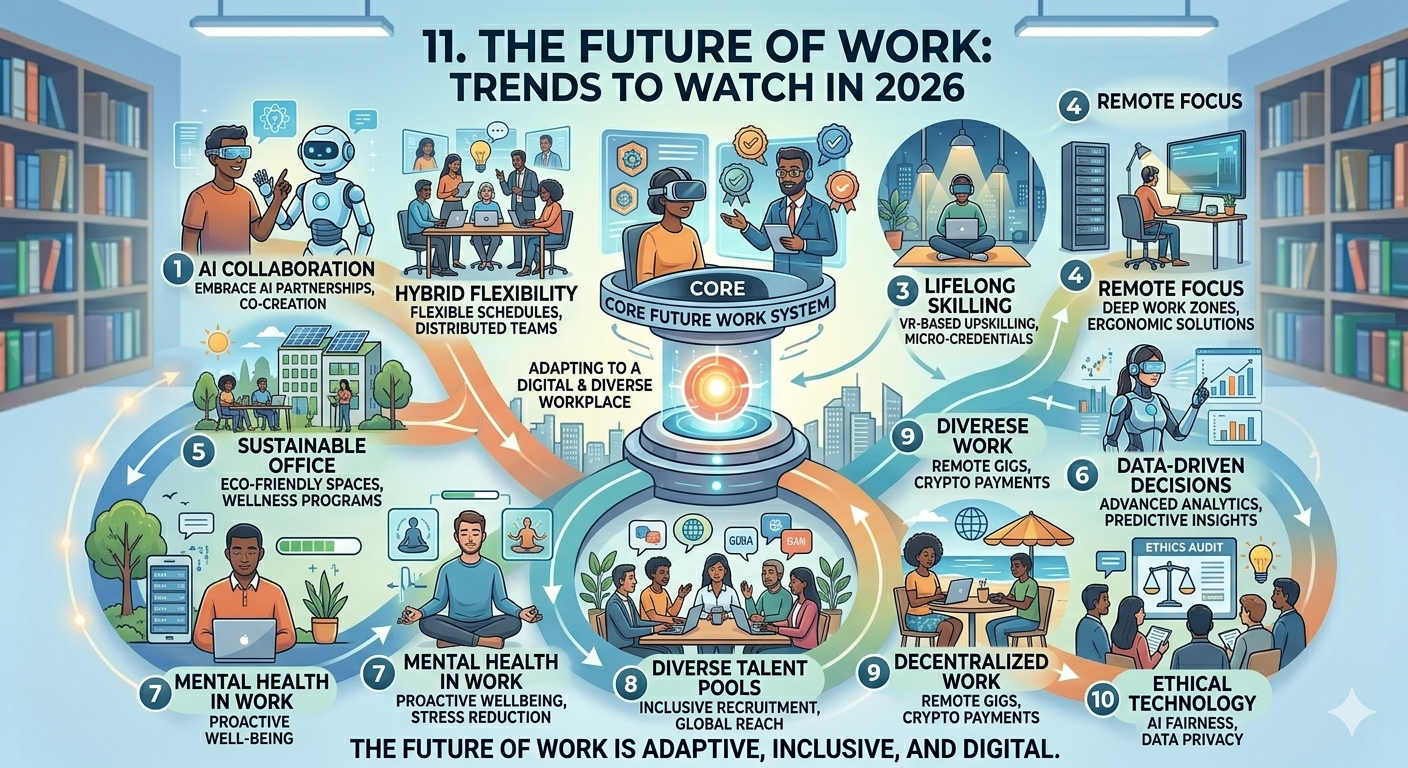
The world of work is undergoing one of the most profound transformations in history. Driven by rapid technological advancements, shifting employee expectations, and global economic changes, the workplace of 2026 looks very different from just a few years ago. Artificial intelligence, hybrid work models, and evolving skill demands are reshaping how organizations operate and how individuals build their careers.
Understanding these trends is essential for professionals, businesses, and students who want to stay relevant and thrive in the future workforce.
The Changing Nature of Work
Work is no longer confined to a physical office or traditional 9-to-5 schedule. The concept of work itself is evolving—becoming more flexible, digital, and skills-driven.
Research from
Deloitte
highlights how connectivity, automation, and new talent models are redefining where, how, and why work gets done. (Deloitte)
In 2026, work is increasingly about outcomes rather than hours, and adaptability has become a core requirement.
1. The Rise of Artificial Intelligence in the Workplace
Artificial intelligence is the most significant driver of change in the future of work.
AI is not just automating repetitive tasks—it is transforming entire job roles. According to research, around 50–55% of jobs are expected to be reshaped by AI in the near future, rather than completely replaced. (BCG Global)
AI is being used for:
- Data analysis and decision-making
- Customer service automation
- Content creation
- Workflow optimization
Recent developments show that advanced systems, including “agentic AI,” can act independently, make decisions, and complete tasks with minimal human intervention. (TechRadar)
This means workers must learn to collaborate with AI rather than compete with it.
2. Human-AI Collaboration Becomes the Norm
Instead of replacing humans, AI is increasingly working alongside them.
Studies show that most workers prefer a combination of human and AI collaboration, where technology enhances productivity while humans provide creativity and judgment. (Gloat)
This shift is creating a new work model:
- Humans handle creativity, empathy, and strategy
- AI handles data, automation, and efficiency
The future workforce will be defined by how effectively individuals can integrate AI into their daily work.
3. The Transformation of Jobs and Skills
The demand for skills is changing rapidly.
Traditional job roles are evolving, and new roles are emerging, particularly in:
- AI and machine learning
- Data science
- Cybersecurity
- Digital marketing
At the same time, soft skills are becoming more important than ever, including:
- Critical thinking
- Emotional intelligence
- Adaptability
According to industry reports, workers with AI-related skills can earn significantly higher wages, highlighting the growing value of technical expertise. (Gloat)
4. The Growth of Remote and Hybrid Work
Remote and hybrid work models have become a permanent feature of the modern workplace.
Key statistics show:
- Around 28% of workdays are now remote, compared to just 5–7% before the pandemic (LinkedIn)
- 77% of remote workers report higher productivity (WorkTime)
- 82% of companies offer flexible work arrangements (DailyRemote)
However, 2026 is also seeing a shift toward hybrid models, where employees split time between home and office.
This model offers:
- Flexibility for employees
- Collaboration opportunities for teams
- Better work-life balance
5. The Shift Toward Skills-Based Hiring
Employers are increasingly focusing on skills rather than degrees.
This trend includes:
- Hiring based on practical abilities
- Emphasizing certifications and experience
- Reducing reliance on traditional education credentials
Companies are prioritizing what candidates can do rather than where they studied.
6. Continuous Learning and Reskilling
In 2026, learning is no longer optional—it is essential.
With rapid technological change:
- Employees must continuously update skills
- Companies are investing in training programs
- Lifelong learning is becoming the norm
Reports indicate that a significant portion of the workforce will require reskilling and upskilling in the coming years. (TechRadar)
Online platforms like
Coursera
are playing a major role in this transformation.
7. The Emergence of New Leadership Roles
As organizations adapt to AI and digital transformation, leadership structures are evolving.
One notable trend is the rise of roles like:
- Chief AI Officer (CAIO)
- Digital transformation leaders
- Data-driven decision-makers
In fact, a large percentage of companies have introduced AI-focused leadership roles to manage technological integration. (TechRadar)
8. The Gig Economy and Flexible Work Models
The gig economy continues to expand, offering more flexible work opportunities.
This includes:
- Freelancing
- Contract-based work
- Project-based employment
These models provide:
- Flexibility for workers
- Cost efficiency for companies
However, they also raise concerns about job security and benefits.
9. Employee Well-Being Takes Center Stage
Organizations are placing greater emphasis on employee well-being.
This includes:
- Mental health support
- Flexible schedules
- Work-life balance initiatives
Employees are increasingly prioritizing well-being over salary alone, influencing company policies.
10. Data-Driven Decision Making
Organizations are relying more on data to make decisions.
AI-powered analytics enable:
- Real-time insights
- Better forecasting
- Improved efficiency
This trend is transforming how businesses operate and compete.
11. Automation and Job Displacement Concerns
While AI creates opportunities, it also raises concerns about job displacement.
Recent reports show that many companies are restructuring workforces due to automation, although new roles are also being created. (Business Insider)
The key challenge is managing this transition effectively.
12. The Evolution of Workplace Culture
Workplace culture is becoming more:
- Inclusive
- Flexible
- Technology-driven
Organizations are focusing on:
- Diversity and inclusion
- Collaboration
- Innovation
Culture is now a critical factor in attracting and retaining talent.
13. The Role of Technology in Productivity
Technology continues to enhance productivity through:
- Automation
- Collaboration tools
- AI-driven insights
Businesses are moving beyond basic digital tools to fully integrated intelligent systems.
14. Global Talent Competition
Remote work has increased global competition for jobs.
Employees now compete with talent worldwide, while companies can hire from anywhere.
This trend:
- Expands opportunities
- Increases competition
- Encourages skill development
15. Ethical and Governance Challenges
The rise of AI and automation introduces ethical challenges, including:
- Data privacy concerns
- Bias in AI systems
- Accountability for decisions
Organizations must establish clear policies and ethical guidelines.
Preparing for the Future of Work
To stay relevant in 2026 and beyond, individuals should:
- Develop digital and AI skills
- Embrace lifelong learning
- Build adaptability and resilience
- Focus on both technical and soft skills
Companies should:
- Invest in employee training
- Adopt flexible work models
- Integrate AI responsibly
FAQs
What is the future of work in 2026?
The future of work in 2026 is defined by AI integration, hybrid work models, and a strong focus on skills and adaptability.
Will AI replace jobs?
AI will reshape many jobs rather than completely replace them, creating new opportunities while changing existing roles.
What skills are important for the future?
Digital skills, critical thinking, adaptability, and emotional intelligence are essential.
Is remote work still relevant in 2026?
Yes, but it is evolving into hybrid models combining remote and in-office work.
What is skills-based hiring?
It focuses on practical abilities rather than formal degrees.
Why is continuous learning important?
Because technology is evolving rapidly, requiring constant skill updates.
What is the gig economy?
A labor market based on short-term, flexible jobs and freelance work.
How is AI changing leadership?
New roles like Chief AI Officers are emerging to manage technological transformation.
What challenges does the future of work present?
Job displacement, skill gaps, and ethical concerns related to AI.
How can individuals prepare for the future?
By learning new skills, staying adaptable, and embracing technology.
Conclusion
The future of work in 2026 is dynamic, complex, and full of opportunities. While technology—especially artificial intelligence—is reshaping industries, the human element remains essential. Skills like creativity, empathy, and critical thinking are becoming more valuable alongside technical expertise.
Success in this new era requires a willingness to learn, adapt, and evolve. By understanding these trends and preparing for change, individuals and organizations can not only survive but thrive in the future workplace.
The future of work is not something that simply happens—it is something we actively shape through our choices, skills, and mindset.